
Sarah
Janice
Jack
Mark
Family -
Who child lives with sometimes
Matt
Shelly
RATAC
Faculty Lecture
Required Reading
Hiltz, B, & Bauer, G., (2003). Drawings in forensic interviews of children. Update, 16(3).
Holmes, L., & Finnegan, M. (2002). The use of anatomical diagrams in child sexual abuse forensic interviews. Update, 15 (5).
Vieth, V. (1999). When cameras roll: The danger of videotaping child abuse victims before the legal system is competent to assess children's statements. Journal of Child Sexual Abuse, 7(4), 113-121.
2
Determining the Young Child's Ability to Understand Truth vs. Lie
Utilization of the * Reality Task
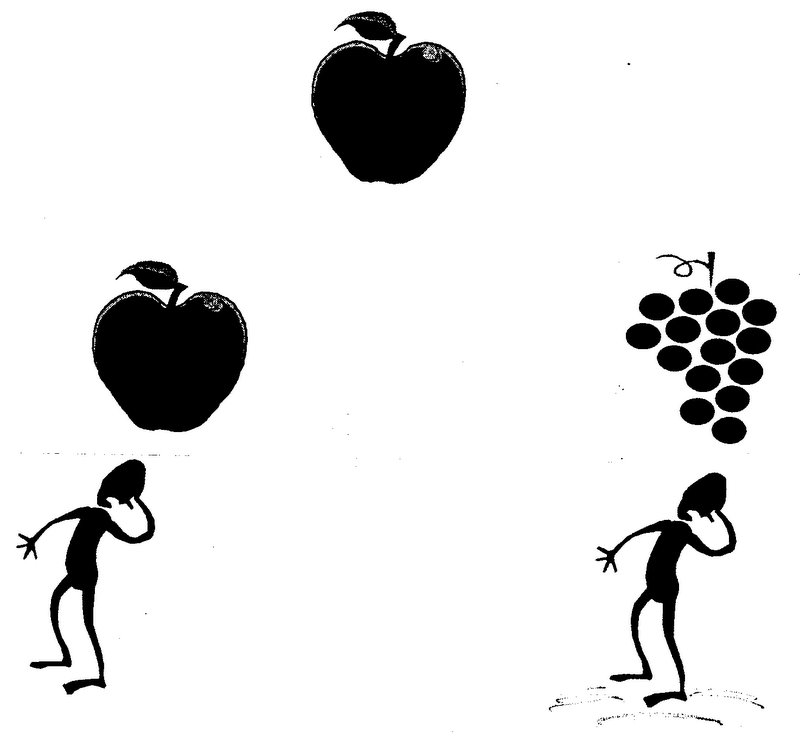
Ask the child: "Which story person told the truth?" and "Which story person told a lie?"
*The Reality Task is taken from the research of Thomas D. Lyon and Karen J. Saywitz. This research is detailed in the journal article "Young Maltreated Children's Competence to Take the Oath" found in Applied Developmental Science, 1999, Vol. 3, No. I, 16-27.
3
Using Drawings in a Forensic Interview
Drawings can be helpful in the following ways:
4
CornerHouse
Forensic Interview Process
RATAC™*
RAPPORT
The purpose is to establish the child's:
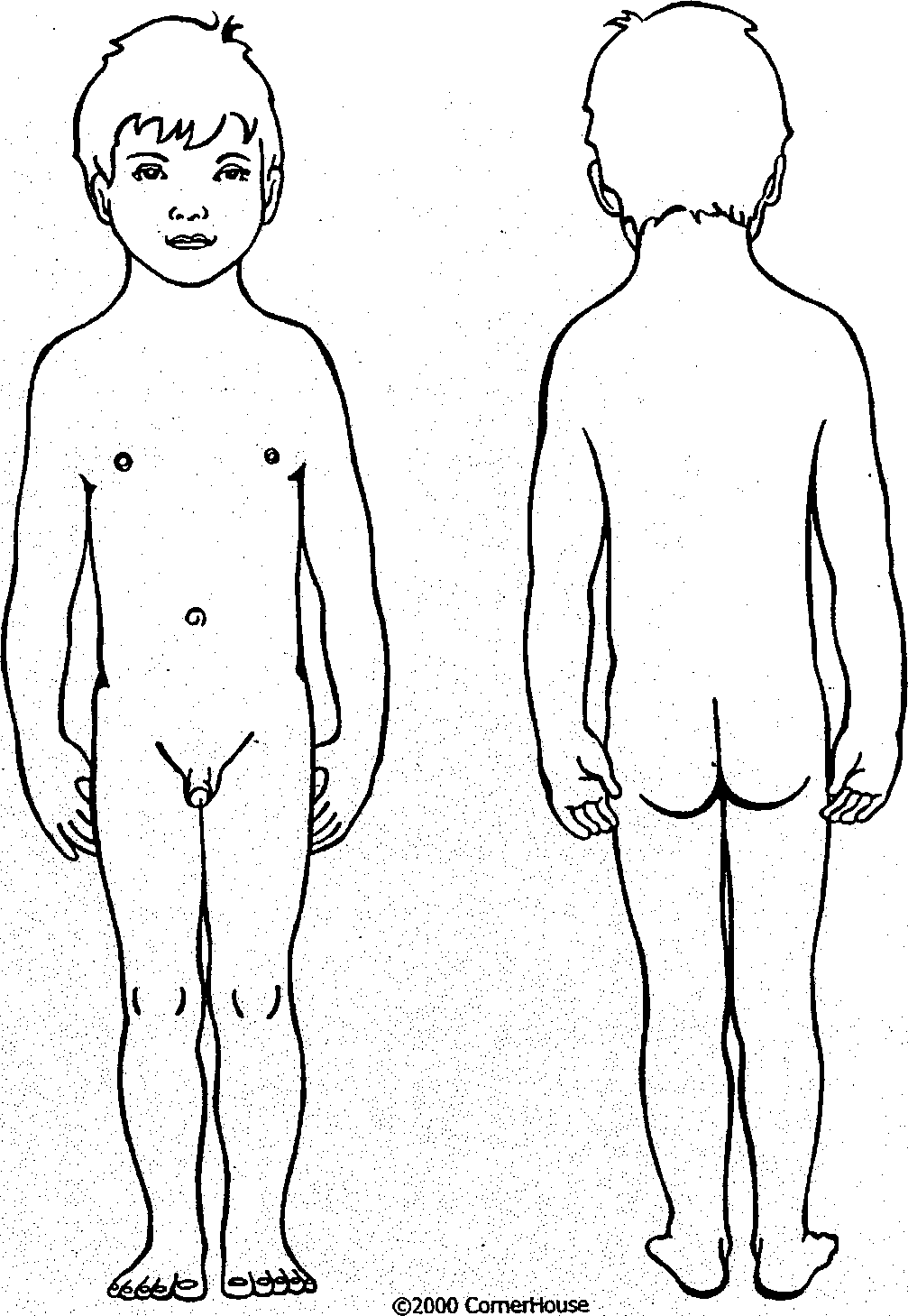
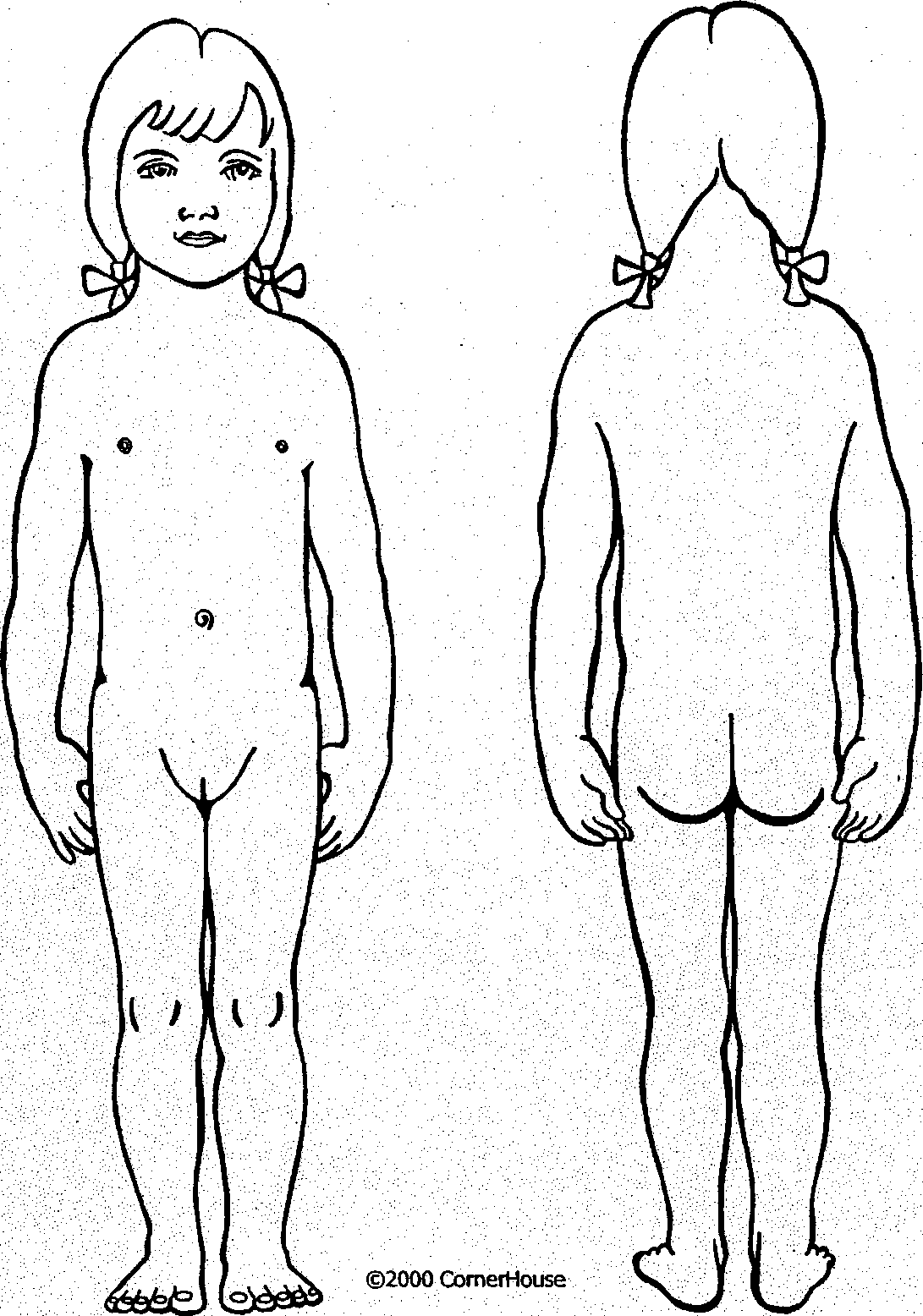
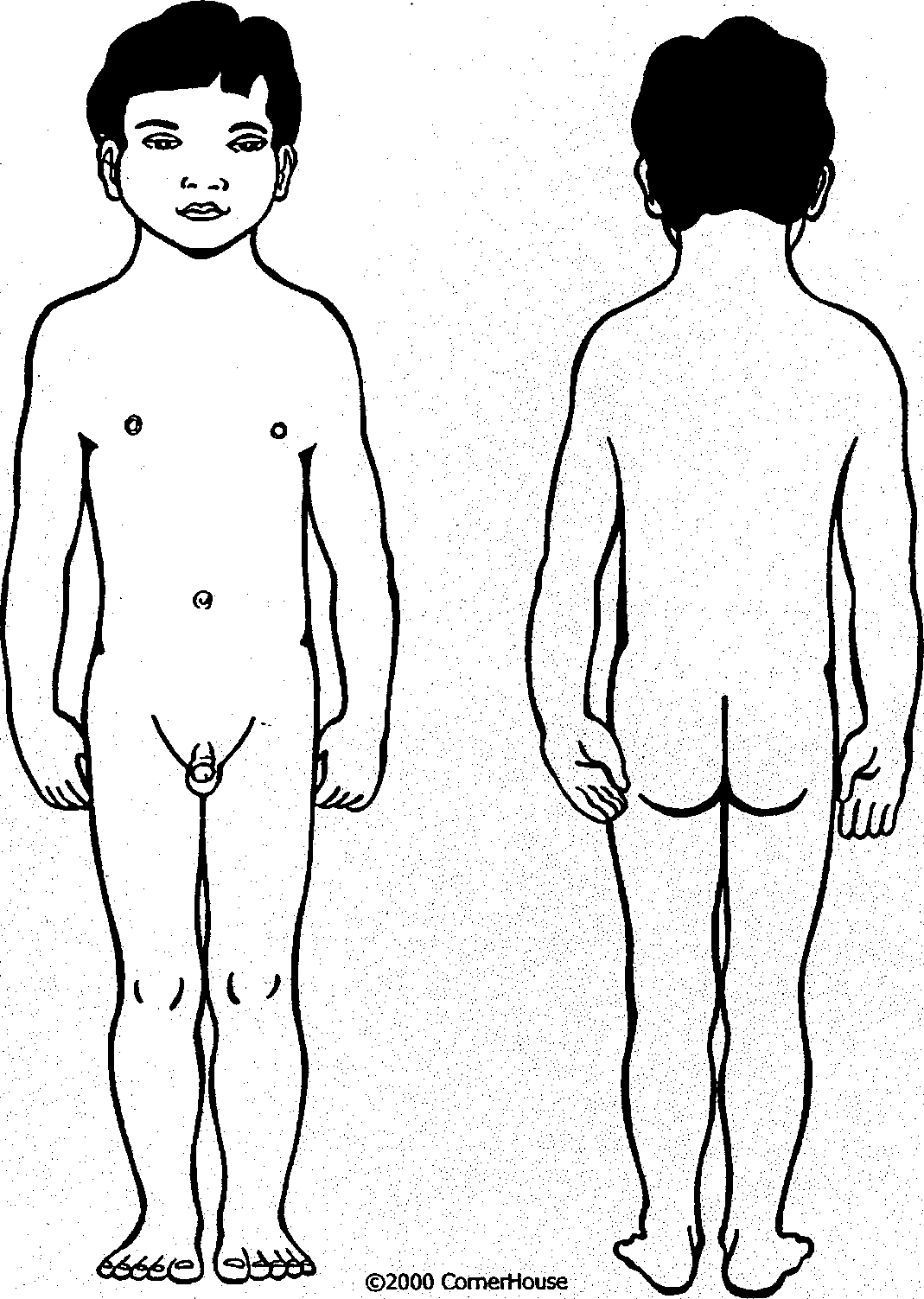
ANATOMY IDENTIFICATION
The purpose is to:
TOUCH INQUIRY
The purpose is to:
ABUSE SCENARIO
The purpose is to:
CLOSURE
The purpose is to:
*Since this is a semi-structured process, one or more of these stages may be modified or eliminated, allowing for the developmental considerations and/or spontaneity of each child.
5
RATAC™ Techniques
Rapport
Comfort
Communication
Competence
Face Picture
6
RATAC™ Techniques
Rapport
Family Circles
7
Anatomy Identification
Age and skin-tone appropriate
Use of language
Anatomy Identification is about the child
Gender Differentiation
8
RATAC™ Techniques
Anatomy Identification
Naming Body Parts
9
RATAC™ Techniques
Touch Inquiry
Begin with touches that would generally be considered a "positive" experience and then follow-up with questions regarding "negative" types of touch.
Positive:
| Follow up with. | "Who gives you_(hugs/kisses/tickles)?" |
| "Where on your body does ____(e.g. Dad)____(e.g. hug) you?" and | |
| "Is that okay with you or not okay with you?" |
| Follow up with: | "What kinds of touches are those?" |
| "Who gives you____(hugs/kisses/tickles)?" | |
| "Where on your body does_(e.g. Dad)_(e.g. hug) you?" and | |
| "Is that okay with you or not okay with you?" |
10
RATAC™ Techniques
Touch Inquiry
Negative:
Listed below are many options for inquiring about unwanted or potentially abusive touch. We recommend that interviewers start with the type of inquiry most appropriate for the child's development and proceed with alternative questioning as needed. Alternative questioning should also be guided by the child's development, context, and the statements of the child.
| Follow up with, | "Where?" and |
| "Has someone touched you in one of those places?" | |
| "Has someone tried to touch you in one of those places?" |
| Follow up with, | "Where?" and |
| "Has someone touched you in one of those places?" | |
| "Has someone tried to touch you in one of those places?" |
| Follow up with, | "Has someone touched you there?" |
11
RATAC™ Techniques
Touch Inquiry
Follow up with: "Did you ever have to______(do that/tell______)?"
Follow up with: "Tell me about that."
Follow up with: "Who did you tell?" and "What did you tell_?"
Follow up with: "Tell me about going to the doctor." Or "How come?'
Follow up with: "Who brought you here today?" or "Who told you about coming here?" and "What did _______ say?" or "Why do you think you are here?"
Don't forget to DEFINE THE TOUCH, find out WHO gave the child the touch, and WHERE ON THE CHILD'S BODY (s)he received the touch.
12
RATAC™ Techniques
Abuse Scenario
13
RATAC™ Techniques
Closure
14
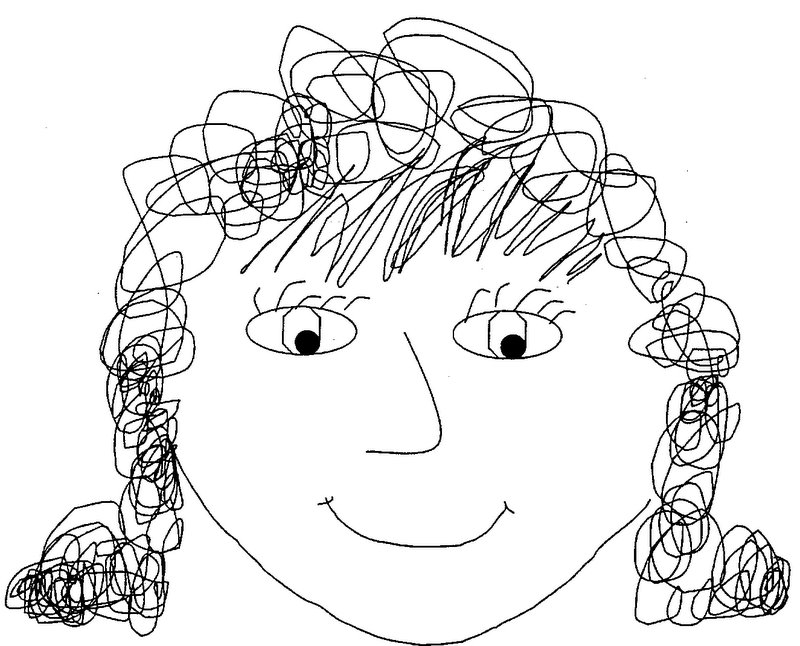
FACE PICTURE
Lori Alli, 6 years old
15
Family Circles
Identify who the child lives with and/or who is in the child's family.
| Family - Who child lives with | ||||
|
|
|
|
|
| Alli, 6 | Mom, Sarah |
Sister 2, Janice |
Brother 14, Jack |
Step-dad, Mark |
Family -
Who child lives with sometimes | ||||
|
|
| ||
| Alli, 6 | Dad, Matt |
Dad's girlfriend, Shelly | ||
| | | | | |||
| | | | | |||
| | | | | |||
| V | V | |||
|
| |||
| Patty, 3 | Daniel, 8 | |||
| (Shelly's kids) | ||||
16
Skill Building Exercise: Rapport
17
Skill Building Exercise: Rapport
18
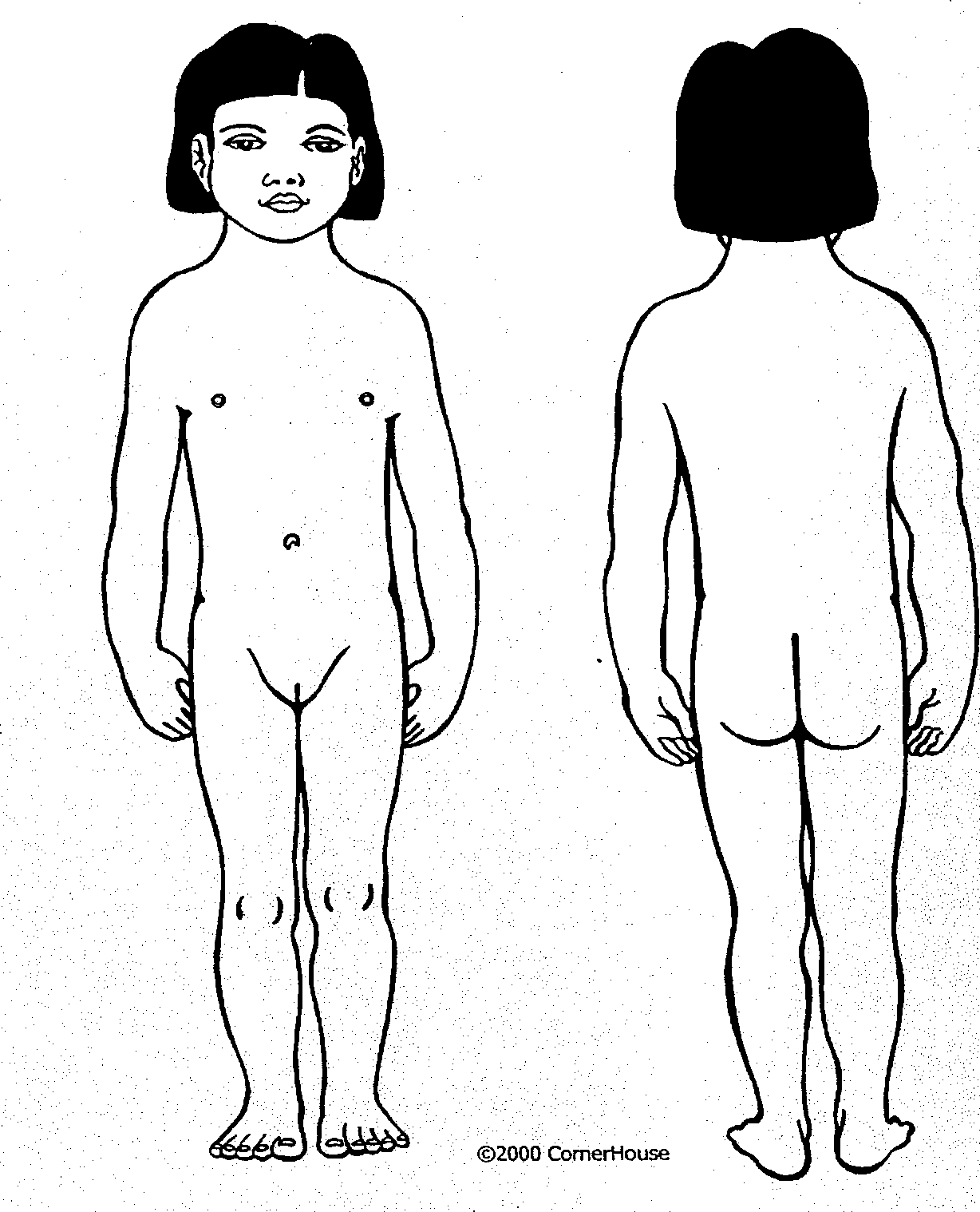
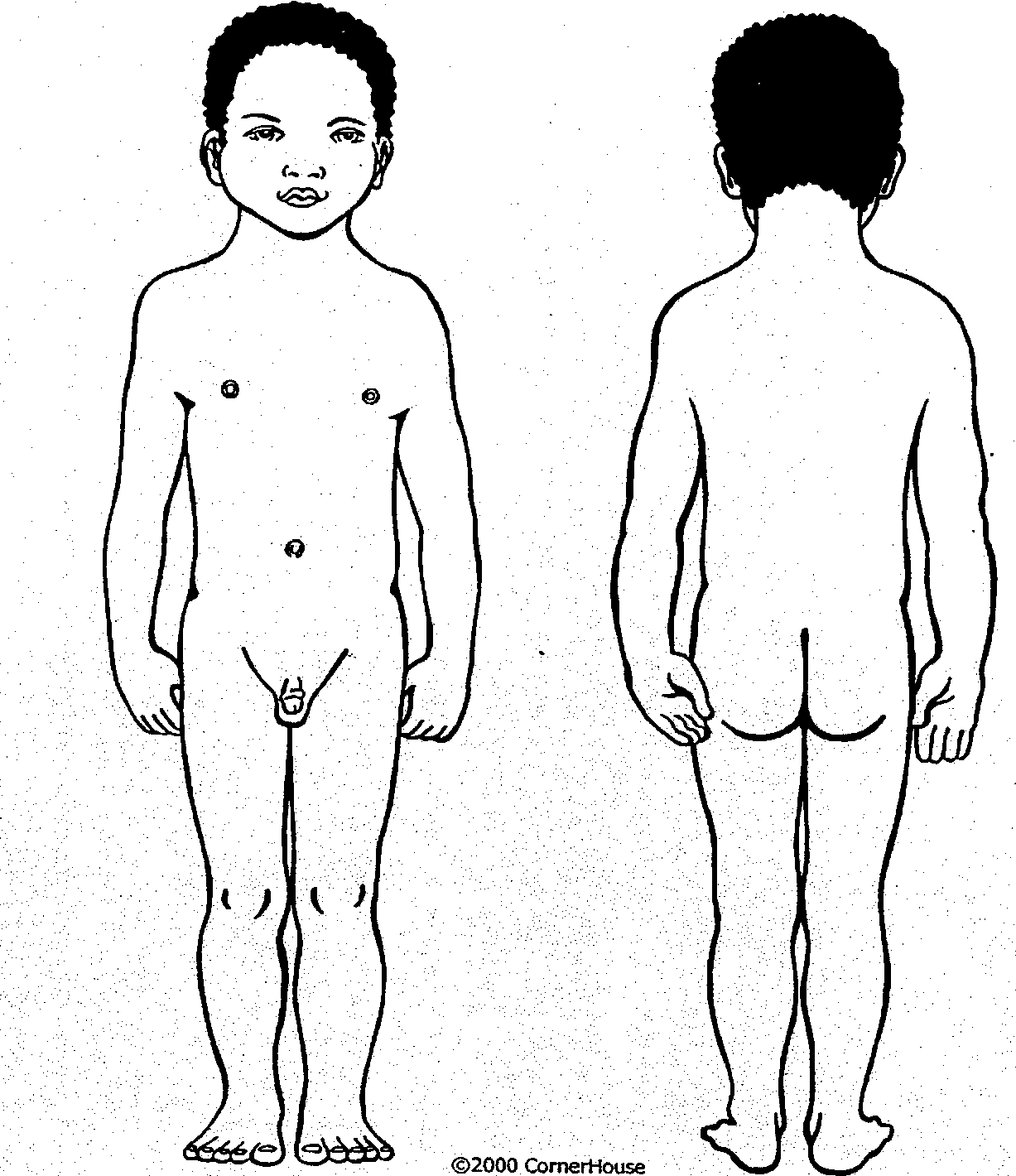
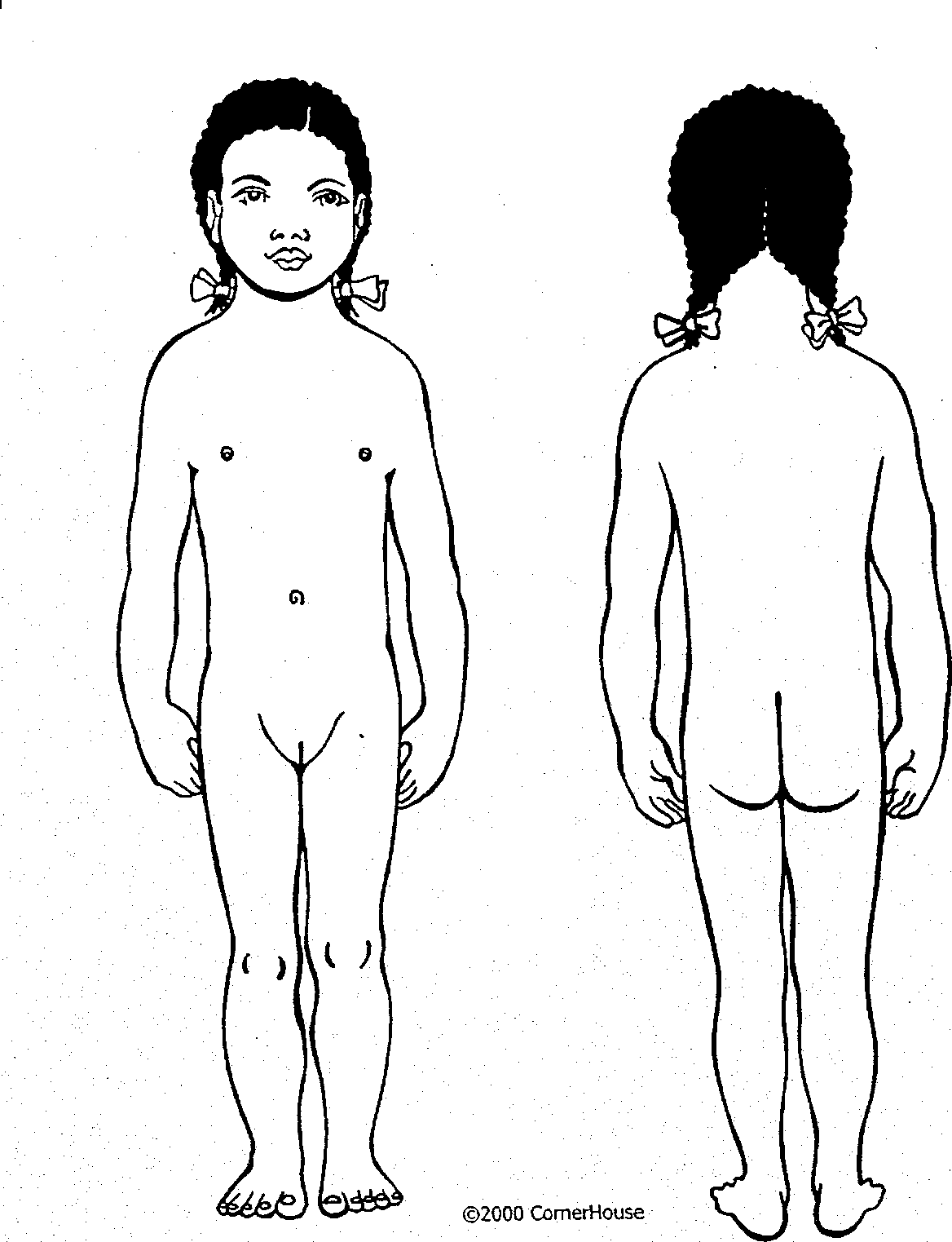
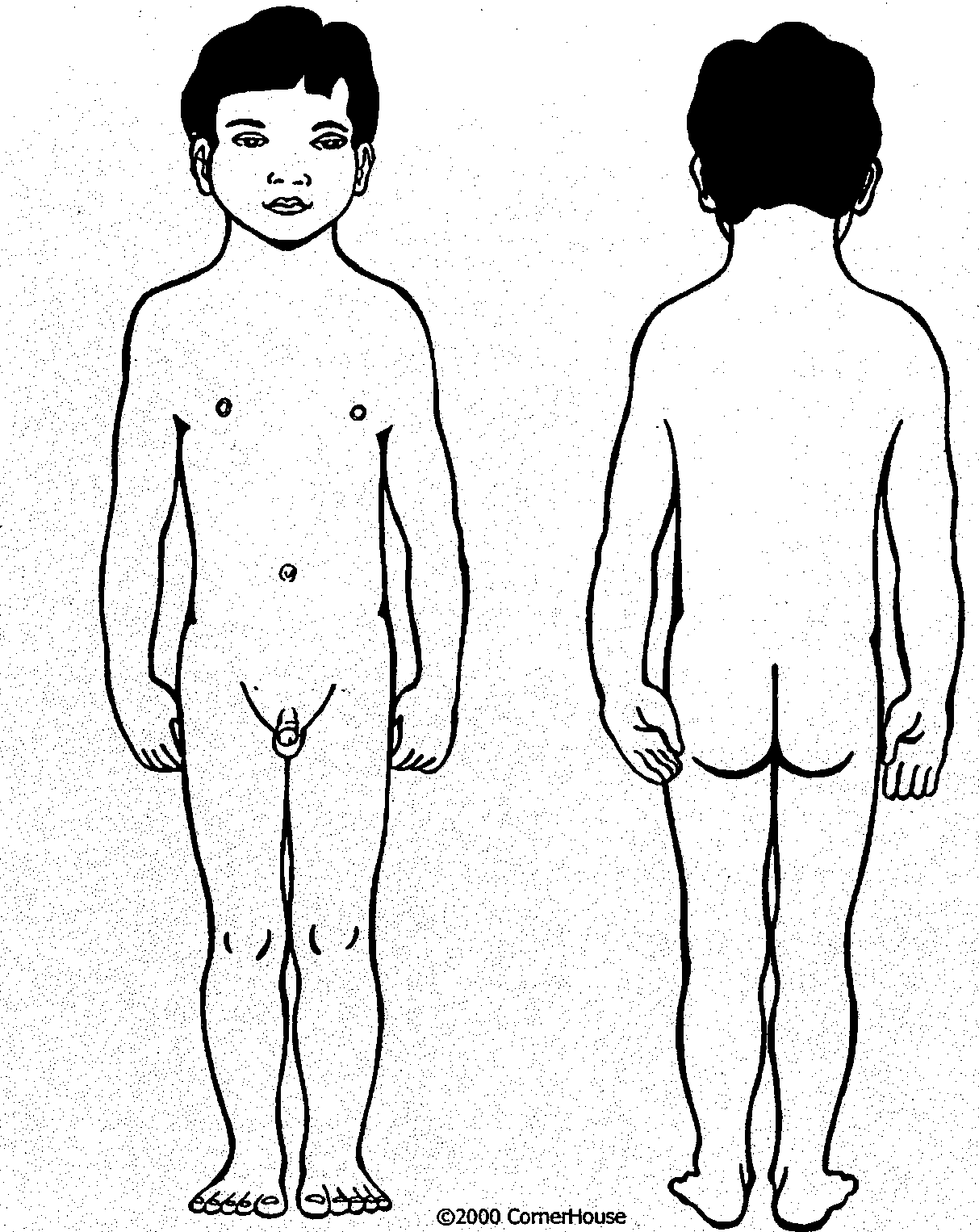
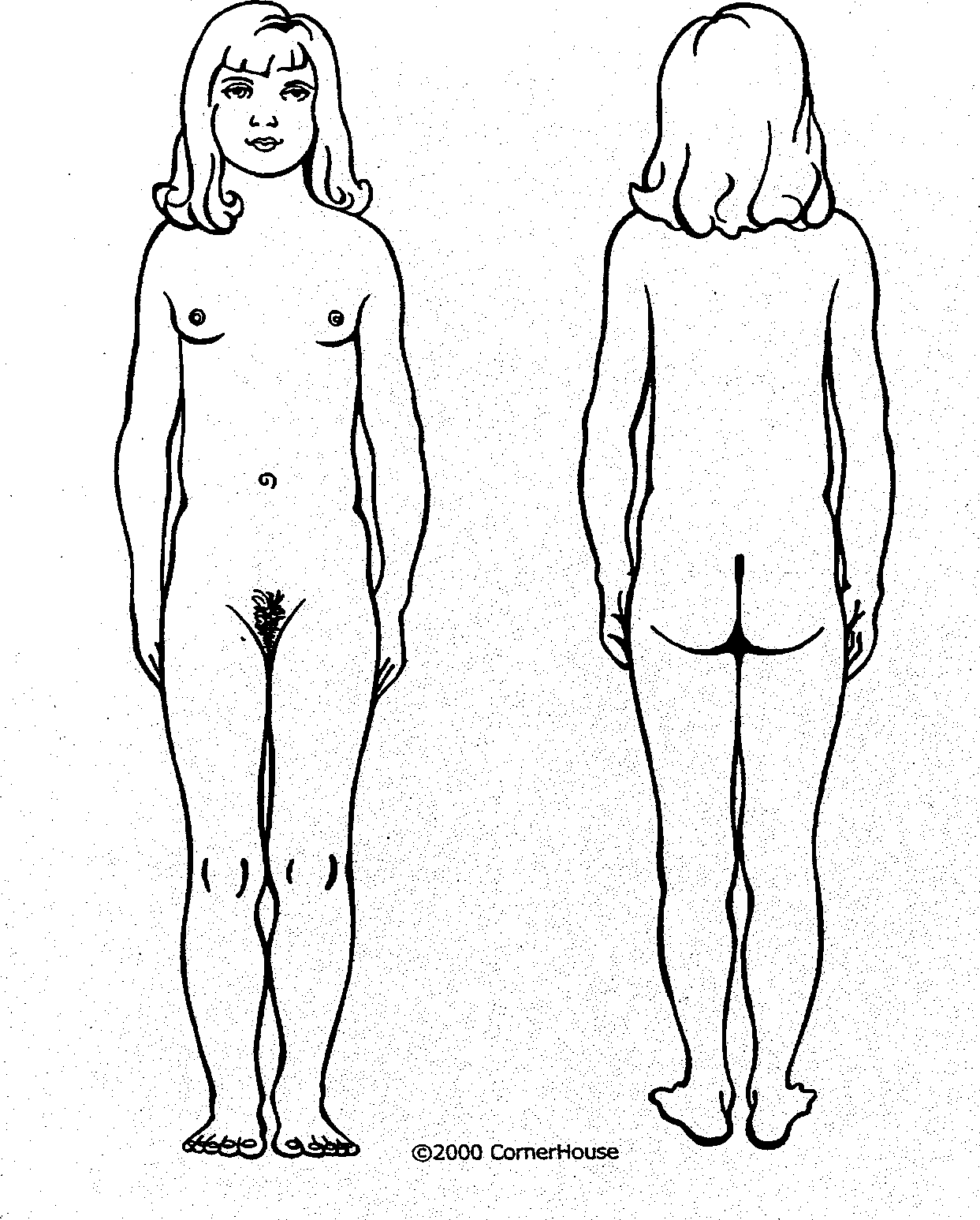
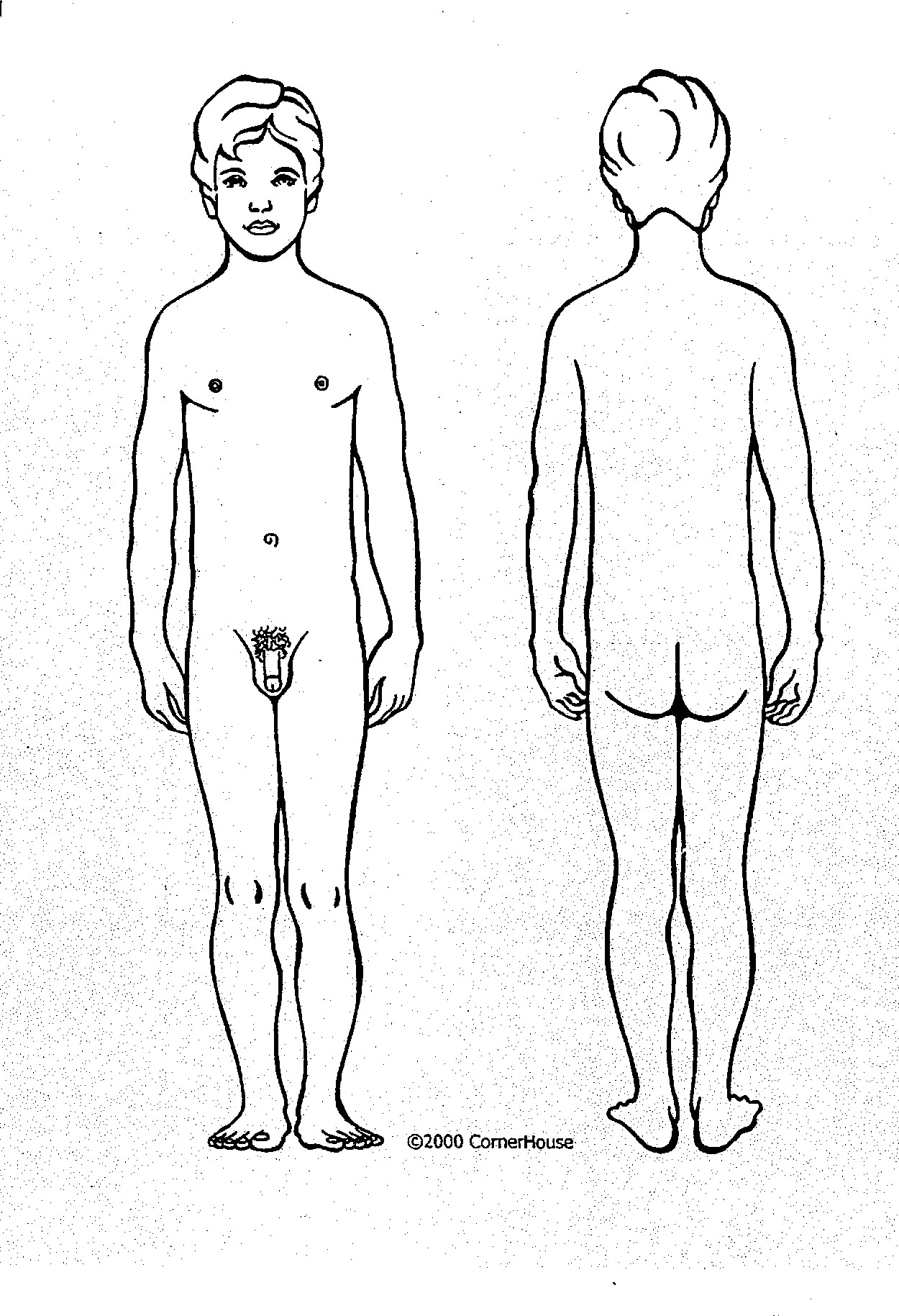
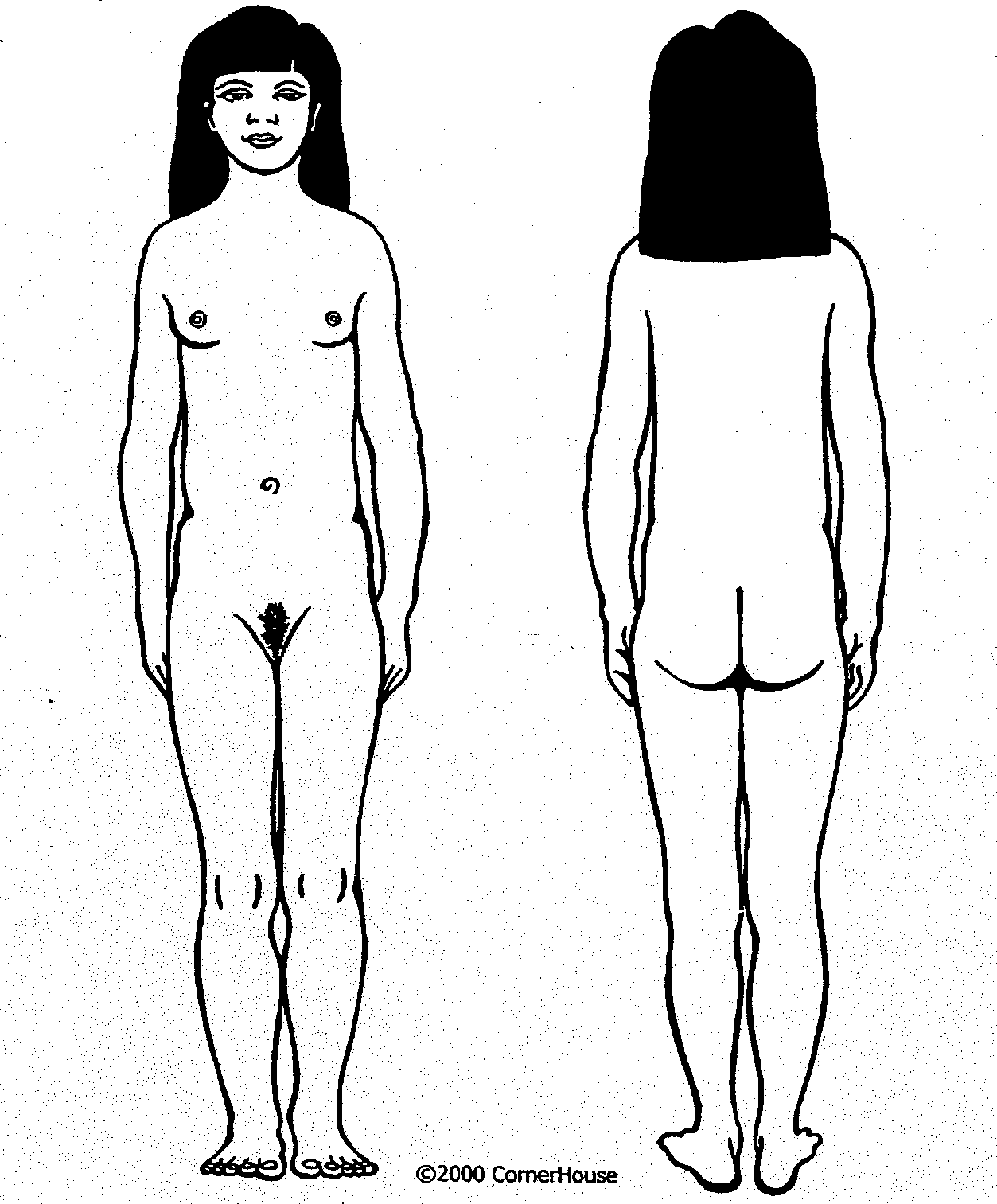
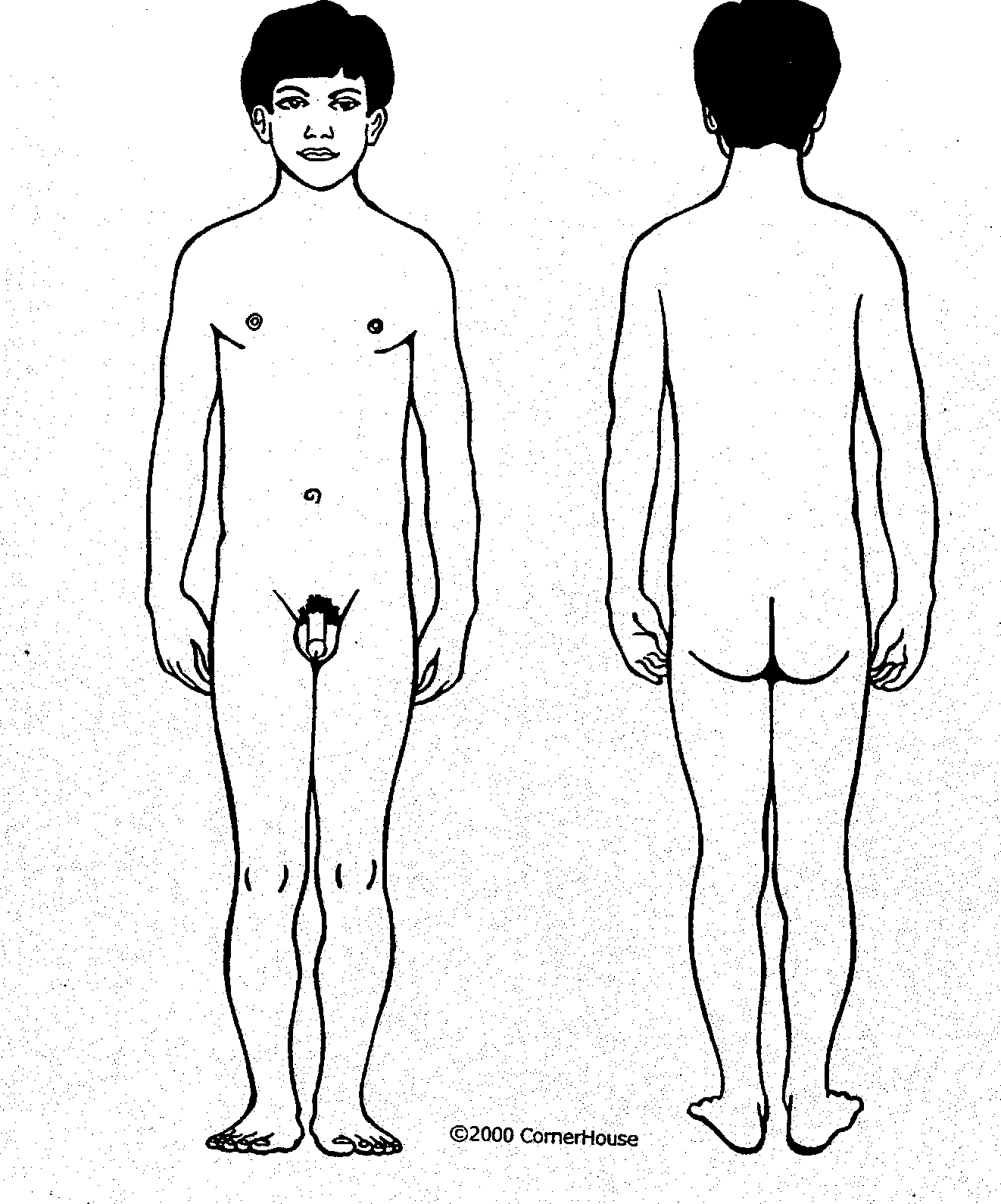
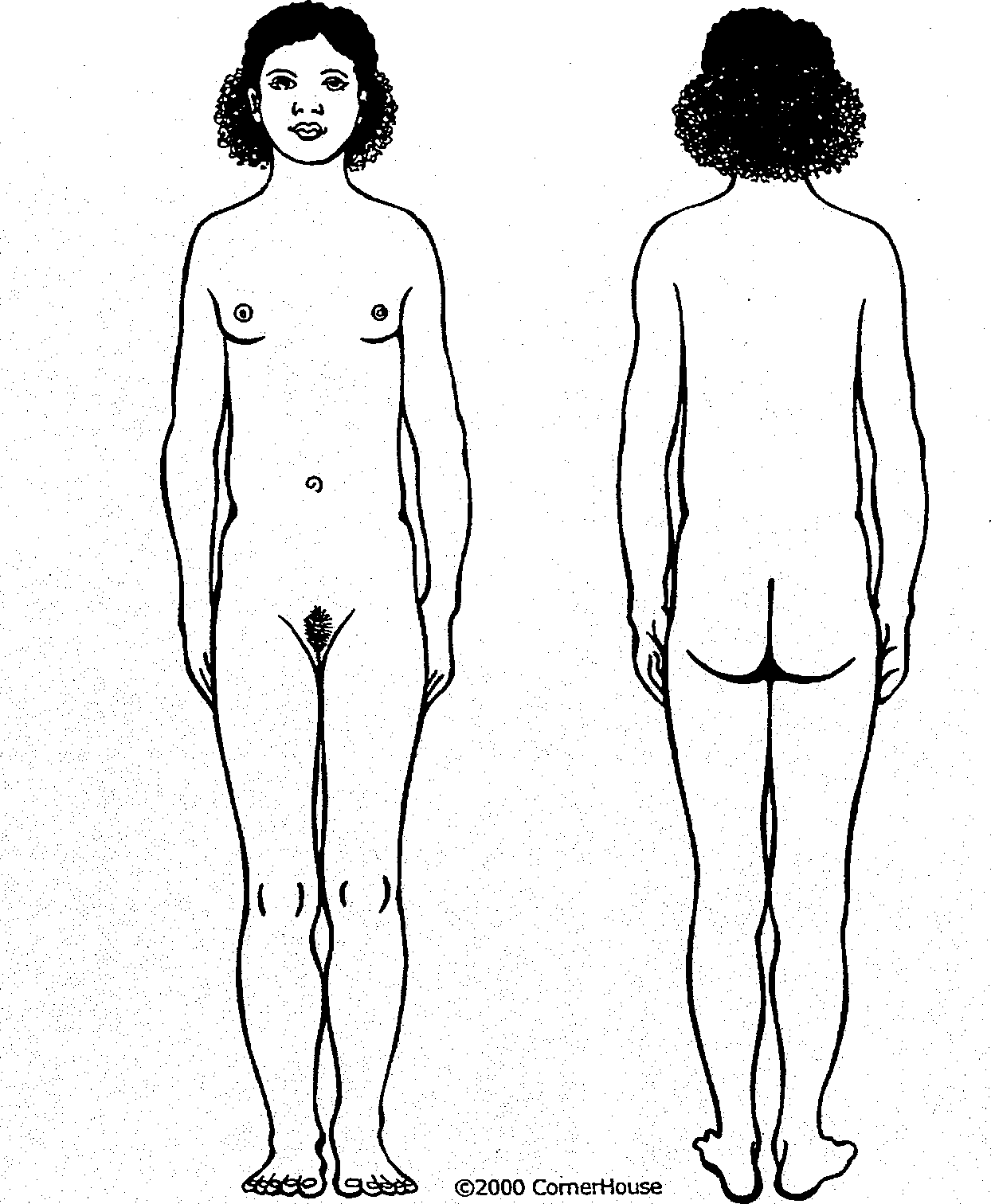
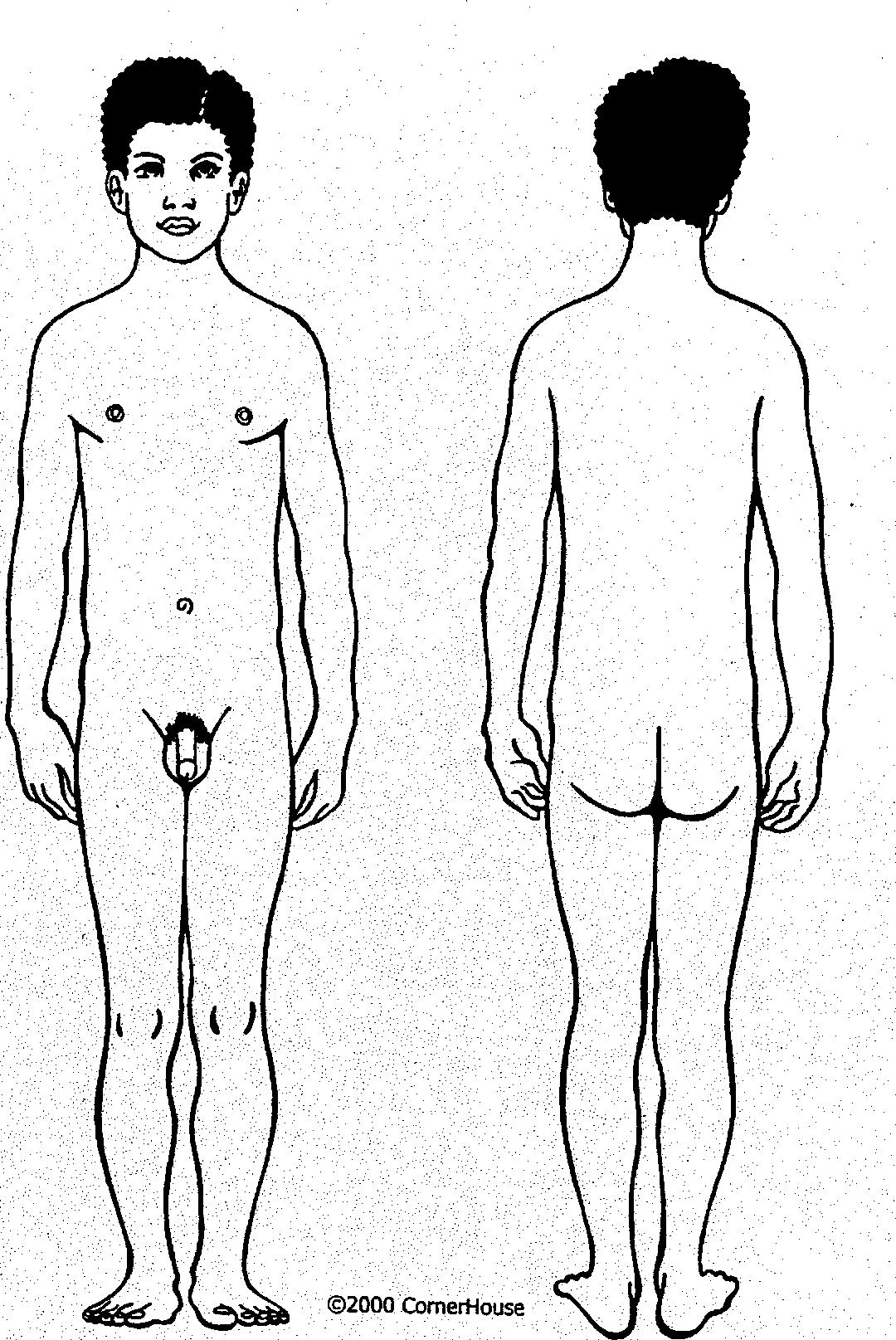
Anatomical Body Diagrams
The diagrams in this section were developed by CornerHouse. They were adapted from diagrams developed by:
> Forensic Mental Health Associates, Orlando, FL;
> My Body diagrams developed by Ann Ahlquist and Patricia Batko, Hennepin County Community Services, 1985; and
> Loa Porter, Grand Portage Human Services, MN, 1993.
To purchase a complete set of the CornerHouse diagrams, please contact CornerHouse.
21
22
23
24
25
26
27
28
29
30
31
SEXUAL SLANG WORDS
These are some terms CornerHouse interviewers have heard children use for various body parts and sexual functions. The terms may or may not have a derogatory meaning for children who use them. For an adult talking with a child about possible sexual abuse, it is important for the adult to use the child's terms as much as possible. Avoid "correcting" the child or showing disapproval of terms the child uses.
Breasts
| balloons | bazongas | bazooms | bosoms |
| boobs | boobies | bazungas | bust |
| bumps | cakes | cantaloupes | cookies |
| fried eggs | headlights | hogans | hooters |
| jugs | knockers | lungs | melons |
| mosquito bites | nibbles | nickles | raisins |
| chest | teats | tee-tees | titties |
Buttocks
| arse | ass | back butt | behind |
| biscuit | bootie | bottom | bum |
| bumper | buns | Butt | caboose |
| can | cheeks | Duff | dupa |
| fanny | flip side | glutimus maximus | hind butt |
| hind end | hindquarters | hinny | keister |
| pooper | rear | Rear end | rump |
| seat | tail | tail-end | tush, tushie |
Female Genitals
| beaver | between-my-legs | biscuit | booty |
| box | cat (kitty) | cookies | coochie |
| crack | crotch | do-do | down-there |
| flower | gash | Gina | goodies |
| hole | honey-pot | hoochee-coochee | kitty-cat |
| money-maker | muff | my-middle-hole | naughties |
| nest | panocha (Span.) | piece | pee-pee |
| personal parts | private parts | privacy, privates | puss, pussy |
| pocketbook | squirrel | snatch | tee-tee |
| thing | twat | Ugly | wee-wee |
| front-butt | nasty | bread | shame-shame |
32
SEXUAL SLANG WORDS
Male Genitals
| balls | bone | cock | cookies |
| dick | ding-a-ling | ding-dong | dingy |
| dinkie | dipstick | dong | doodle |
| down there | dork | fletcher | fuck pole |
| garden hose | gland | gonads | gun |
| hose | hung job | It | John-Thomas |
| Johnson | joint | joy stick | junk |
| knife | knob | lizard | log |
| male part | meat | member | middle leg |
| nuts | organ | pecker | pee-pee |
| peeny | peeper | Peg | personal part |
| Peter | Peter Rabbit | pickle | pisser |
| poker | pole | polish | prick |
| privates | private part | privacy | pud |
| putz | ram rod | Rod | Roger |
| Roscoe | salami | schlong | schlontz |
| schvanz | schwantz | snake | stick |
| stick shift | thing | third leg | tinkler |
| tool | tube steak | twanger | unit |
| wang | wee-wee | weenie | whacker |
| William | wing-wang | wing-wong | winkie |
33
Skill Building Exercise: Anatomy Identification
34
Skill Building Exercise: Anatomy Identification
35
Review Skill Building Exercise: Rapport
36
Review Skill Building Exercise: Rapport
37
Review Skill Building Exercise: Anatomy Identification
38
Review Skill Building Exercise: Anatomy Identification

39
RATAC
Required Reading
40
Reprinted with permission from:
Hiltz, B, & Bauer, G., (2003). Drawings in forensic interviews of children. Update, 16(3).
Drawings in Forensic Interviews of Children
Barb Hiltz, LGSW1
Grant Bauer, LICSW2
Forensic interviews and interview protocols are increasingly incorporating anatomical dolls, anatomical diagrams and/or drawings, as methods of enhancing a child's disclosure. Various types of drawings can be used by the child, the interviewer or both at various stages of the interview process. Drawings are helpful for a variety of reasons, including assessment, investigation and potential prosecution. This article suggests several reasons to use drawings in forensic interviews, several types of drawings that may be helpful, and uses for drawings that would be inappropriate in a forensic setting.
Use of drawings in forensic interviews
Establishing comfort: Drawings may be used initially to build rapport, and throughout the interview to establish comfort for the child. Gross and Hayne report that "drawings may reduce the perceived social demands of the interview. That is, children asked to draw may simply feel more comfortable than children merely asked to tell; this increased comfort level, in turn, may facilitate children's ability to talk about the target event."3
Clarification: Drawings may be used as a tool to clarify all or some of a child's verbal disclosure, which may promote understanding between the child and interviewer. For example, a child may disclose multiple incidents occurring in different rooms or levels of a building. Having a child draw the layout of the location he or she is describing may provide the interviewer with a clearer picture of that child's experience.
Enhancing recall of detail: There is evidence that children who have the opportunity to draw in conjunction with verbalizing their experiences report significantly more information.4 In a study with 3-6 year olds, the children who were given the opportunity to draw and tell about their own emotional experiences reported more than twice as much information as children asked to tell only .5
Prodding memory: Drawings may help to facilitate disclosure of sexual abuse by helping a child move closer to the abusive event.6 Gross and Hayne hypothesize that drawing may allow the child to generate more of his or her own specific retrieval cues, which facilitates a verbal report.7 Said another way, drawing one aspect of a particular event may remind children about other aspects of the same event.
Reducing intensity: Describing an abusive event may be an intense experience for a person of any age. This feeling of intensity and pressure may be magnified for a child in a small room, talking to someone whom he or she does not know. A flip chart or pad of paper provides another focus for the child's eyes and an outlet for potentially intense feelings. Drawing, rather than
41
verbalizing, certain details of an experience may also remove some of this pressure.8
Documentation: Some types of drawings can serve as an immediate reference for both the interviewer and the child. For example, if the child is describing key players in his or her experience, such as family members or abusers, a simple face picture, along with a name, can help the interviewer and child remember who has been discussed. Other techniques, such as lines or boxes to differentiate residences, can also be useful.
Refocusing the child: It may be difficult to focus small children, even for relatively short periods of time. Drawing engages children in a quiet, interactive activity, thereby allowing the interviewer time to ask additional investigative questions. If children become increasingly active or disengaged in the interview process, refocusing them to the drawing surface may return their attention to the task at hand.
Evidence: In cases of physical or sexual abuse, the child is invariably the only witness to the crime. 9 Any drawing made by the child during disclosure can potentially be used for evidentiary purposes in court. 10 For example, a child may draw a sexually abusive act, indicating it as something that happened to him or her. Drawings may be less graphic and still have corroborative significance. For example, if a child draws the setup of the room where the child says the abuse occurred, that picture, along with a photograph of the crime scene, could act as a piece of evidence to corroborate the child's disclosure.
As stated in the American Bar Association's Guidelines for Fair Treatment of a Child Witness, "The child should be permitted to use anatomically correct dolls and drawings during his or her testimony."! 1 Since the forensic interview can be viewed as an extension of the child's testimony, drawings should be actively considered in the interview setting as well.
Types of drawings used in forensic interviews
Child's face picture: During the initial or rapport building stage of an interview, the interviewer can draw a picture of the child's face, perhaps in conjunction with the child. This allows the interviewer time to talk with the child and assess the child's verbal and cognitive abilities, while establishing comfort. A picture of the child's face also lets the child know that he or she is the most important person in the interview room.
Other family/face circles: A discussion of the child's family or caregivers may help an interviewer identify key individuals in the child's life, which may be useful if the child discloses an abusive event. A genogram (or a modification of such a tool) can provide a visual reference when discussing the child's family. Additional information about friends, perpetrators or others may be added throughout the interview. Children may point to these drawings to clarify individuals or reduce intensity.
Pets: Drawing a child's pets can be a useful technique for building rapport with children. In some situations, animals may be a factor in the abuse, for example, if a perpetrator threatened to harm a pet if the child told of his or her experience.
Anatomy identification: Printed anatomical diagrams are commonly used in forensic interviews to identify body parts. Some forensic interviewers prefer to draw pictures of human figures, using these to elicit the child's names for body parts. Such drawings may also be used with children who are reluctant to say the word of the part that was touched.
42
Crime scene: Children's depictions of crime scenes can be helpful in many ways, including clarifying a child's disclosure, enhancing the recall of detail, prodding the child's memory and providing evidence for potential prosecution. The child's ability to create a helpful crime scene drawing will vary by developmental level.
Instruments used: If a child describes being abused by certain instruments, or if he or she describes creams, jellies or other aids, it can be useful to have the child draw a picture of what these implements looked like and/or where they were kept. Again, the child's ability to do this will vary depending on developmental level.
Inappropriate uses of drawings in forensic interviews
Therapy: Although drawings are commonly used in the therapeutic treatment of sexually abused children, it must remain clear that a forensic interview differs in function, purpose and scope from a therapeutic session. Any interpretation of children's artwork must remain in a therapeutic setting and handled by a practitioner specifically trained in art therapy and issues of sexual abuse.
Independently for evaluation: In the absence of a verbal disclosure or other factors, it is inappropriate to use a child's drawings in a forensic interview to diagnose a child as having been or not been sexually abused. Drawings should be seen as one of many forensic interviewing tools to be used in combination with other techniques.
Fantasy: It is important to focus the child in the realm of reality whenever possible. Admittedly, this can be difficult when dealing with the creative minds of young children. When asking children to draw, interviewers should avoid using words like "play," "pretend," "make-believe" or "imagine." If children use such terms they should be redirected, with the interviewer saying something such as, "we only talk here about what really happened."
Conclusion
Drawings should be viewed as one of many tools that can be considered during the forensic interview. While drawings can be an integral part of a competent and comprehensive interview, they can also be detrimental if used in ways that impede or distract a child from other forms of communication, or in leading or suggestive ways that threaten the validity of the child's disclosure. Interviewers must fully understand the benefits and limitations of drawings so they can defend their interview methods in court.
Drawings in a forensic interview should be facilitated by a trained child abuse professional who is both comfortable and familiar with their purpose and function. Training programs such as Finding Words™, by the National Center for Prosecution of Child Abuse 12 and CornerHouse, 13 teach appropriate uses of drawings in forensic interviews. Finding Words™ training is available at the national level and at the state level in South Carolina, Mississippi, Indiana and New Jersey. State programs will also be available this year in Georgia and Missouri, and by 2004, in West Virginia, Maryland and Illinois. If you are interested in establishing a Finding Words™ course in your state, contact the National Center for Prosecution of Child Abuse at (703) 549-4253.
Research for this publication was gathered with the assistance of Melanie Spuches, Intern,
43
APRI's National Center for Prosecution of Child Abuse.
1 Forensics Services Coordinator for CornerHouse, a Child Abuse Evaluation and Training Center, Minneapolis, MN.
2 Forensic Interview Specialist for APRI's National Center for Prosecution of Child Abuse, Alexandria, VA.
3 Gross, J., & Hayne, H. (1998). Drawing facilitates children's verbal reports of emotionally laden events. Journal of Experimental Psychology, 174.
4 Gross, supra note 3.
5 Gross, supra note 3.
6 Faller, K. (1988). Child sexual abuse: An interdisciplinary manual for diagnosis, case management and treatment. New York: Columbia University Press, 166.
7 Gross, supra note 3.
8 Burgess, A.W., McCausland, M.P., & Wolbert, W.A. (1981). Children's drawings as indicators of sexual trauma. Perspectives in Psychiatric Care, 19(2), 50-58.
9 Gross, J. & Hayne, H. (1999). The effect of drawing on children's interview performance over long delays. Journal of Experimental Psychology: Applied, 5,265-283.
10 Burgess, McCausland & Wolbert (1981); Kelley, S.J. (1984). The use of art therapy with the sexually abused child. Journal of Psychosocial Nursing and Mental Health Services, 22(12), 12-18; Cohen-Liebman, M.S, (1995). Drawings as judiciary aids in child sexual abuse litigation: A composite list of indicators, The Arts in Psychotherapy, 22(5), 475-483.
11 American Bar Association (1985). Criminal Justice Policy, Guidelines for Fair Treatment [online]. Although the guidelines use the term "drawings," they may be referring to anatomical diagrams, which are simply outline drawings of nude people at various stages of development and can be used as an interview aid. See Lori S. Holmes and Martha J. Finnegan, The Use of Anatomical Dolls in Child Sexual Abuse Forensic Interviews, 15 (5) Update 2002. If, however, a created document such as a diagram is an acceptable forensic interview aid, then certainly a drawing created during an interview, perhaps entirely by the child, should also be acceptable.
12 APRI's National Center for Prosecution of Child Abuse, Alexandria, VA, 703-549-4253.
44
Reprinted with permission from:
Holmes, L., & Finnegan, M. (2002). The use of
anatomical diagrams in child sexual abuse forensic
interviews. Update, 15 (5).
The Use of Anatomical Diagrams in Child Sexual Abuse Forensic Interviews
Lori S. Holmes, AdA, LISWi and Martha J. Finnegan, MSW2
Introduction
Minimal research has been done on the use of anatomical diagrams in child sexual abuse forensic interviews. Unlike anatomical dolls, which have been researched in depth, anatomical diagrams3 have been used for years with little or no guidance on their proper use in the forensic setting. Lately, there has been much discussion regarding the type of diagrams to use and how to use them during a child sexual abuse interview. To assist users of anatomical diagrams, the following suggestions are offered.
What Are Anatomical Diagrams? 4
Like anatomical dolls, anatomical diagrams are an interview aid. 5 Anatomical diagrams are outline drawings of nude people at various stages of development: young school-age children, adolescents, and adults. The diagrams look like real people in that they include facial and age-appropriate body features. The diagrams are of both males and females of * various ethnicities. 6
For What Ages Are Anatomical Diagrams Appropriate?
Although some may disagree,? anatomical diagrams can be used with any age child. With young children the diagrams are often invaluable to obtain names for body parts or to direct questioning regarding sexual touch. 8 For older children (or even developmentally delayed adults) the diagrams provide another method of communication that allows interview subjects to distance from their own bodies. 9
Using Anatomical Diagrams in an Interview The purpose:
As with any interview aid, interviewers should be able to articulate the purpose for using anatomical diagrams. There are at least four purposes for using the diagrams.
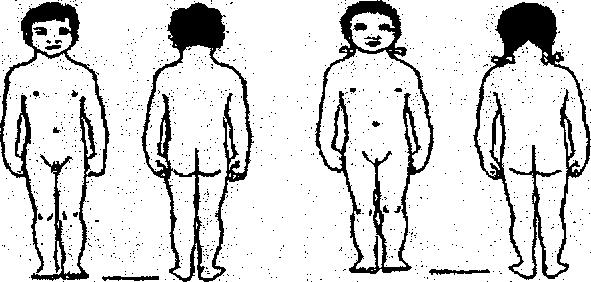
First, a number of authorities recognize the value of the diagrams in assisting the child to identify body parts, 10 thereby lessening the chance the interviewer will unwittingly suggest the name of a body part and the child will adopt that name. Second, the diagrams may assist the
45
interviewer in determining a preschool or developmentally delayed child's understanding of, and ability to distinguish between male and female gender. 11 Third, interviewers can ask children to indicate on the diagrams where sexual touching occurred. 12 Research findings indicate that anatomical diagrams are effective in obtaining body touch information from children. 13 Fourth, anatomical diagrams are useful for clarification purposes. 14 For example, if a child uses different words to name a certain body part, the interviewer can ask the child to indicate the location of that body part on the diagram.
The process:
The usefulness of any aid is influenced by the way it is presented and how the child is instructed regarding its use. Anatomical diagrams are no exception. This process applies to the four acceptable uses identified above.
After building rapport, show the child a male and female anatomical diagram that is consistent with the child's ethnicity and age. When interviewing an adolescent, use the adolescent diagrams and when interviewing an adult, use the adult diagrams. When interviewing a four-year-old girl, the interviewer would show the child a girl and boy diagram of a preschooler. The diagram that is the same gender as the child should be shown to the child first. Both genders are used in order for the interviewer to show neutrality. If the initial report suggests the girl's mother is the perpetrator, showing only the girl diagram may subject the interviewer to being attacked in court as a biased investigator who assumed the mother was the perpetrator and thus chose to limit the child's options.
For preschool children (to determine the child's understanding of and ability to distinguish between gender), fold the diagram in half so that just the front side of the diagram is showing. To show both the front and backside at the same time can be confusing to a young child. The child may think she is looking at a picture of two separate children. Ask the child, "Is this a picture of a girl or a boy?" Next show the child the opposite gender diagram and repeat the question. Then ask the child "Which picture is most like you?" For children ages six and older, gender differentiation does not need to be established, unless the child has developmental delays or there are concerns about the child's ability to differentiate genders. With children in this age range, simply tell them that you are going to show them a couple of pictures. Explain that you show these pictures to kids that you talk to because the pictures have all of their body parts, and you want to know what they call different parts of their body. The next step of the process applies to all children. Starting with the same gender diagram as the child, ask the child to name the body parts on both the front and backsides of the diagrams. There is no prescribed order to proceed, but generally start at the head and ask the child "What do you call this?" as you point to a variety of body parts, such as the eyes, mouth, hands, breasts, bellybutton, genitals, buttocks, leg, and foot. As the child names each body part, the interviewer can label the part on the diagram. 15 The child should never be made to feel that there are "correct" or "incorrect" names for body parts. Questions like, "Do you call that part anything else?" or "Have you ever heard another name for that part?" may imply to
46
the child that he has given you a wrong answer. Whatever the child calls the body part is okay. Also, interviewers should refrain from any judgmental comments or emotional displays of shock or disgust. If interviewers are uncomfortable with the words a child uses for her body parts, the child will pick up on these cues and will likely shut down.
Some children may be hesitant about naming certain body parts or claim they don't know what that part is called. If this occurs, first offer the child reassurance. Let the child know that it is okay to use any words she wants while talking with you in the interview room. If the child is still hesitant, an interviewer can ask what her same gender parent calls that body part. Another option is to tell the child "Think about what you want to call that part and we'll come back to it in a minute." A final option may be to ask the child a multiple-choice question. For example, if a child is hesitant about naming breasts, the interviewer can say, "Some kids call them breasts, chest, or something else. What do you want to call them today?" Once the child hears the interviewer using words for breasts, she may feel more comfortable using her own term. She may, however, pick one of the options. This should not be considered a suggestive question as the interviewer offered the child the choice of "or something else," allowing the child the opportunity to choose her own name for the body part.
Understanding a child's terminology for body parts at the outset of a forensic interview will help the interview process flow more smoothly. If the child discloses later on, the interviewer and child will already have a common understanding for body part names and will not have to take the time mid-disclosure to name the parts of the body. Herein lies the opportunity to also use the diagrams to allow the child to point to the places where he was touched or was made to touch. Once used for this purpose, the diagrams may also serve as a memory aid, cueing the child's memory regarding other incidents involving his or the perpetrator's body. 16
The Cover-Up "Controversy"
As mentioned above, anatomical diagrams are nude diagrams of males and females of different ethnicities at various stages of development. Some authors suggest alternatives to these diagrams, which may include "gingerbread" diagrams, or diagrams where the genitalia are covered by a swim suit. 17 Some interviewers have decided to use diagrams with no anatomy. 18 Some jurisdictions have requested diagrams with "clothes on" in case the child reports fondling "over the clothes. 19
By introducing diagrams with bathing suits or clothes the interviewer may be displaying her own discomfort with the discussion of breasts, buttocks, and genitalia. This is not an uncommon occurrence since many adults in our society have learned from their own upbringing that private parts are not to be discussed. Children often learn the correct names of most body parts, but they may not have been taught any names for the intimate parts of the body or they may have been taught names that are silly or incorrect. This creates an atmosphere of shame and sends children the message "that these parts of the body are uncomfortable or different 20 from other body parts. A child interviewer may inadvertently be introducing "a sense of shame
47
or guilt 21 to the child by covering up the genitalia, which ultimately influences the child's ability to disclose sexual abuse. Interviewers spend time creating a child-friendly interview setting because they want children to feel comfortable talking about sexual touches, even if it is a difficult subject. Why then, would an interviewer cover-up the sexual areas of the body on the diagram, adding to the child's sense of shame and secrecy and ultimately conveying the message "It's not okay to talk about those body parts here"? Introducing the type of anatomical diagram shown in this article does not imply if, where, or how a child was touched. Those issues are explored in detail throughout an interview. However, even if a child was touched "over the clothes" the interviewer should clarify exactly "where" on the body the child was touched. The diagrams shown here are the best way to do that.
It is helpful to remember that the diagrams do not replace a child's verbal account of the abuse but are simply tools to assist children in communicating their experience. Numerous courts have permitted children to use anatomical diagrams, anatomical dolls or other props as demonstration aids while testifying. 22 If courts allow the use of diagrams or dolls to assist children when testifying, it is puzzling that interviewers would deny or dilute this assistance to children during an investigative interview.
Conclusion
The preceding information reviews the uses for anatomical diagrams in child sexual abuse forensic interviews. As with any tool, anatomical diagrams are not an end to themselves, but rather one aid that can enhance the child sexual abuse forensic interview. Determinations regarding sexual abuse should never be made on the use of anatomical diagrams alone. Various organizations have the anatomical diagrams for purchase, including Forensic Mental Health Associates of Orlando, FL (407-351-2308) and CornerHouse, an Interagency Child Abuse Evaluation and Training Center in Minneapolis, MN (612-813-8300).
1 Lori S. Holmes is the Training Coordinator at CornerHouse, an Interagency Child Abuse Evaluation and Training Center in Minneapolis, MN.
2 Martha J. Finnegan is the Child Interview Specialist at the FBI's Innocent Images National Initiative in Calverton, MD.
3 Jon R. Conte et. al., Evaluating Children's Reports of Sexual Abuse: Results from a Survey of Professionals, 61 Am. J. Orthopsychiatry 428 (1991); Mary E. Large, The Interview Setting, in MDIC Handbook: A Guide to the Establishment of Multidisciplinary Interview Centers for the Investigation of Child Sexual Abuse (Kee MacFarlane ed., 1995).
4 The diagrams below depict a pre-school aged Asian boy and African American girl. For a description or copy of diagrams depicting other ethnicities and age groups, contact CornerHouse at (612) 813-8300.
5 While this article is written about child sexual abuse interviews, it should be noted that many of the principles can also be applied to child physical abuse and child witness interviews.
6 CornerHouse, Anatomical Diagrams (2001); Groth, N and Stevenson, T., Anatomical Diagrams for Use in the Investigation and Intervention of Child Sexual Abuse (1990).
7 Wendy Bourg et. al., A Child Interviewer's Guidebook (1999).
8 Barbara W. Boat & Mark D. Everson, What Tools Are Appropriate to Facilitate Interviews with Children? in Handbook for Child Protective Practice 70 (Howard Dubowitz & Diane DePanfilis eds., 2000).
9 Melissa M. Steinmetz, Interviewing for Child Sexual Abuse: Strategies for Balancing Forensic and Therapeutic Factors (1997).
10 CornerHouse, CornerHouse Interagency Child Abuse Evaluation Center Child Sexual Abuse Forensic Interview Training Manual (2002); Assessing Sexual Abuse of Young Children (Kee MacFarlane & Jill
48
Waterman eds., 1986); Erin Sorenson et. al., Handbook on Intake and Forensic Interviewing in the Children's Advocacy Center Setting (1997); Am. Prof 1 Soc'y on the Abuse of Children, American Professional Society on the Abuse of Children Practice Guidelines: Investigative Interviewing in Cases of Alleged Child Abuse (2002).
11 CornerHouse, supra note 6.
12 Am. Prof 1 Soc'y on the Abuse of Children, supra note 10.
13 Margaret S. Steward & David S. Steward, Interviewing young children about body touch and handling, in 61(4-5) Monographs of the Society for Research in Child Development, 61 ( Serial No. 248, 1996).
14 Bourg et. al., supra note 7.
15 These diagrams should be retained as evidence for possible use in court.
16 Bourg et. al., supra note 7.
17 Steinmetz, supra note 9 (1997).
18 Bourg et. al., supra note 7.
19 Personal communication with Lori Holmes, Training Coordinator, CornerHouse, in Minneapolis, Minn. (2002).
20 Debra W. Haffher, From Diapers to Dating: A Parent's Guide to Raising Sexually Healthy Children (1999).
21 Id.
22 See e.g. Phillips v. State, 505 So.2d 1075, 1077 (Ala. Crim. App. 1986) (permitting the use of dolls as a demonstration aid); Pittman v. State, 178 Ga. App. 693, 344 S.E.ed 511, 512 (1986) (permitting use of diagrams as demonstration aid); See generally, John E.B. Myers, Evidence in Child Abuse and Neglect Cases § 6.10 (2000).
49
Reprinted with permission from:
Vieth, V. (1999). When cameras roll: The danger of
videotaping child abuse victims before the legal system is
competent to assess children's statements. Journal of
Child Sexual Abuse, 7(4), 113-121.
When Cameras Roll:
The Danger of Videotaping Child Abuse Victims Before the
Legal System is Competent to Assess Children's
Statements*
Victor I. Vieth
Those who believe children are easily led into making false allegations of abuse have called on courts and legislatures to require investigative interviews of children to be audio and video recorded. This demand has become the "rallying cry" of defense attorneys, VOCAL, and defense experts "whose involvement in these cases is largely made possible by videotape, without which they would be hard pressed to evaluate such techniques."i
Many investigators and prosecutors also advocate the videotaping of statements taken from child abuse victims."ii While some child advocates oppose the video or even audio taping of child abuse victims,"iii the trend is to record interviews of children alleging abuse. Some states have passed laws requiring interviews to be video and audio recorded.iv Courts also tend to encourage video taping even when the procedure is not required and deem the failure to record a factor in determining whether the child's statement is reliable.v Many states reward the videotaping of interviews with child victims by permitting courts to admit the tapes as substantive evidence.vi
In the nine years I served as a rural prosecutor, my small jurisdiction routinely videotaped interviews with child abuse victims and videotaping proved instrumental to our success in investigating and prosecuting these crimes.vii Before we activated a video camera, however, we required our investigators and prosecutors to undergo rigorous training in the art of speaking to a child about abuse."viii In turn, we hoped to use our knowledge to educate any ill-informed judge as to the reliability of the statements we were recording.ix If deemed "reliable", Minnesota law allows the out of court statements to be admitted as substantive evidence.x In most cases we were successful in getting our videotapes admitted as evidence. When we failed, the failure resulted more from technological problems with the recording of the interview and not the interview itself.xi
50
In my experience, then, videotaping can be a powerful weapon in the fight against child abuse."" Unfortunately, videotaping is not a panacea to the woes inherent in the handling of these cases.
Videotaping, by itself, does not help the investigator or the prosecutor. Technology can record an interview for posterity but it cannot make a bad interview good. In a review of the transcripts of 42 videotaped interviews of child sexual abuse victims, researchers concluded that the majority of interviewers failed to follow well established interview guidelines.xl"
In many cases, this means a child abuse victim will fall through the cracks simply because the interviewer does not know how to speak to a child in a manner which allows the child to reveal any abuse. It is wise, for example, to instruct a young child that he or she can and should correct any mistakes made by the interviewer. When not given this instruction, a young child may not correct an interviewer's mistakes. Consider the following example:
Interviewer: Is it good or bad to tell a lie?
Child: G.A. touched me.
Interviewer: Jesus loves me? Is that what you said?
Child: Yeah.xiv
As another example, interviewers should encourage and not interrupt the free flow of information which comes when a child gives a narrative account of abuse. Interruptions may cost investigators important pieces of information. Consider the following interview error:
Interviewer: Can you tell me what happened to you?
Child: Yeah.
Interviewer: What happened to you?
Child: We was in Alton Park. He took Jo's keys somewhere and then he told me to//
Interviewer: Sit up and sit right. Big girls supposed to talk real loud for me.xv
51
Videotaping does not prevent mistakes such as these, videotaping merely reminds us of the interviewer's lost opportunity to detect and protect a child from abuse.
Videotaping, by itself, does not assist a defense attorney who must advise a child abuse perpetrator or who must prepare for a child abuse trial.xvi This is because any such advice and preparation necessarily centers on the credibility of the child's statement. If, however, the defense attorney has little knowledge of the manner in which children communicate, he will be poorly equipped to evaluate the child's credibility. For example, if a pre-school aged victim is asked during an investigative interview as to the frequency with which her father abused her, she may respond "a million times." The attorney with a poor grasp of child development may zero in on the statement as proof the child is unreliable. After all, it could not literally have happened a million times. In reality, it is the question, not the answer which is bizarre. Young children often have a knowledge of numbers but do not appreciate the value associated with the figures. In all likelihood, the child was simply conveying the message the abuse happened a lot.xvii If the jury is properly alerted to this child development issue,xviii the defense attorney will look conniving or foolish in having raised the issue.
Videotaping, by itself, does not help the court determine if a child's out of court statement is reliable and should be admitted as substantive evidence. In the same vein, videotaping does not, by itself, enable a judge to determine whether the interviewer unduly suggested information to a child and whether these suggestions may have planted a false memory in the child's mind. If the judge viewing the tape has not received training in linguistics, child development, memory and suggestibility, and the manner in which children reveal abuse,xix then the court is watching the tape as a layperson, not a professional. As a result, any judgment rendered by the court has no more validity than the opinion of any person pulled into the courthouse from the street.
Some judges or other court officers attempt to wade single-handedly through the vast array of social science research relevant to resolving this issue. Without an experienced guide, such a judge may grab only the most publicized research, not the most relevant. A judge may read Ceci and Bruck's popular book Jeopardy in the Courtroomxx and be left with the impression that children are less than reliable. Indeed, I am told of a judge who held up
52
Jeopardy in the Courtroom at a judicial conference and told his colleagues the book is all they need to know about the reliability of children's accounts of abuse.
A judge whose knowledge is limited to the work of Ceci and Brack is not qualified to evaluate most of the children's statements which crosses his or her desk. This is because Ceci and Brack's work is most applicable to cases involving multiple pre-school aged children.xxi Most of the children who come into court are much older than the children in Ceci and Brack's research. Indeed, the average age of a child abuse victim making his way into the legal system is ten yearsxxii and, as a whole, children this old are no more suggestible than adults.xxiii
If courts and legislatures continue the trend of requiring statements of children to be recorded and if these statements continue to be scrutinized to determine if they are sufficiently reliable to be admitted as evidence,xxiv then steps must be taken to ensure that court personnel are adequately trained. Failure to do so places the fate of children in the hands of amateurs.
What, then, must be done? First, every federal and state jurisdiction must establish a comprehensive training program to teach court players the art of speaking to a child. At a minimum, the course should cover linguistics, child development, memory and suggestibility issues, and the process by which children disclose abuse. Students should not only learn the material through lectures, but through homework, and hands on experience. Students should be required to read the relevant research and, to ensure the homework is completed, to pass a test. Ideally, students should be required to interview a child about a non-abuse event such as a trip to the zoo and be critiqued by a child psychologist or other professional skilled at speaking to children. The course should be a minimum of 40 hours in length.xxv
Second, judges, attorneys, police officers, social workers, and anyone else who will be involved in investigating, prosecuting, defending, or judging cases of child abuse must successfully complete the training program. Anyone failing to do so should forfeit the privilege to investigate, prosecute, defendxxvi, or to preside as a judge in a case involving the testimony or out of court statements of a child abuse victim. This mandate could come from the legislature, the courts, the bar or other associations involved in the licensing of these professionals.
53
Third, each federal and state jurisdiction must set up a system of continuing education for the aforementioned professionals. Those failing to keep updated in this field will lose their certification to participate in an investigation or court proceeding involving an allegation of child abuse.
Fourth, every state must modify its rules of court to ensure that children forced to testify are questioned competently. Just as we should not require a witness who speaks Spanish to respond to questions posed in English, we should not require children to answer developmentally and linguistically inappropriate questions. The fact that such abuses take place daily in America's courtroomsxxvii does not reflect our dislike of children but rather our ignorance of how to speak to and for them.
Since courts and legislatures are increasingly encouraging practitioners to videotape interviews of child abuse victims, it is not unreasonable to expect, even to demand that those who conduct and those who evaluate these interviews be adequately trained.
Most jurisdictions already insist that social workers, police officers, and attorneys be licensed. The proposal advanced in this paper merely specifies that members of these professions desiring to speak to abused children or to evaluate their statements be qualified to do so.
It is also not unreasonable to expect these professionals to remain current with the research as it pertains to the interview of abused children. Numerous journals and associations exist to assist the professional in this regard. The concept of continuing education requirements in order to maintain their professional license is not new to police officers, social workers, or lawyers.
If we are to undertake the task of listening to and evaluating the statements of children who articulate abuse, it is elementary that we do so competently. The possibility, however remote, that an investigator will lead or even coerce a child into making a false accusation, or the more real danger that an incompetent investigator will fail to empower a child to disclose abuse calls upon us to demand the highest standards of professionalism.
This call is so clear that our delay in acting is, to say the least, curious. Perhaps our delay is attributable to the fact that helping children does not fulfill our needs.xxviii As adults, we are past the age where we need to fear most strangers. The strength and maturity which
54
once failed us now protect us. Accordingly, we may articulate a desire to help children but our willingness to act is limited by the extent action inconveniences us.
It is certainly true that the proposed reforms will inconvenience a number of professionals. The inconvenience of one or two weeks of course work and the ongoing commitment to stay abreast of the field, however, pales in comparison to the inconvenience child abuse poses to a single victim.
Our society clearly understands both the needs of abused children and what must be done to competently serve these victims. Though it is too late to attain the honor of acting timely, we can still avoid the disgrace of having never acted.
* This article appears in 7(4) journal of child sexual abuse (1999) and is reprinted with permission of the author and publisher.
i David Hechler, The Battle and The Backlash 208 (1988).
ii Debra Whitcomb, Elizabeth R. Shapiro, and Lindsey D. Stellwagen, When the Victim is A Child 60 (1985).
iii See Lucy Berliner, Paul Stern, and Catherine Stephenson, Should Investigative Interviews of Children be Recorded? 7 Journal of Interpersonal violence 277,278-284 (1992). Some scholars caution courts to avoid memory and suggestibility issues altogether, arguing the research is not yet at a level where courts can apply this research. See Brian K. Holmgren, Expert Testimony on Children's Suggestibility: Should it be Admitted? 10 APSAC ADVISOR 10 (Summer 1997).
iv Id. at 278; MINN. stat.sec. 626.556, subd. 10(I)(j)(l)(2)(1996).
v See e.g. State v. Michaels, 136 N.j. 299,642 A.2d 1372,1383 (1994). The United States Supreme Court has also indicated that videotaping an interview may be a factor in determining the reliability of a statement. Although the court has declined to require that interviews be videotaped, the court also noted that such procedural guidelines "may well enhance the reliability of out-of-court statements of children regarding sexual abuse..." Idaho v. Wright, 497 U.S. 805, 110 S.Ct. 3139,3148 (1990).
vi See Child Abuse and Neglect State Statute Series, Volume rv, Number 21, Admissibility of Videotaped Statements (developed by the National Center on Child Abuse and Neglect working with the National Center for Prosecution of Child Abuse).
vii See Victor I. Vieth, A Strategy for Confronting Child Abuse in Rural Communities, 28 the prosecutor 15 (September/October 1994); Victor I. Vieth, In My Neighbor's House: A Proposal to Address Child Abuse in Rural America, 23 hamline L. rev._(forthcoming 1998).
viii Our written protocol required those interviewing abused children to successfully complete an interview program developed by CornerHouse, a child abuse evaluation and training program located in Minneapolis, Minnesota.
ix Prosecutors can use pre-trial motions as a means of educating judges. For example, a prosecutor can file a motion requiring all parties to speak to a child witness in an age appropriate manner. Attach to the motion the relevant social science research you wish the judge to consider. Even if the court denies the motion, you have begun to educate the judge about this issue. For a discussion of the use of pre-trial motions in a child abuse case, see Daniel S. Armagh, "Pre"-Trial Motions in Child Abuse Cases, 11 UPDATE, number 3 (1998) (published by APRI's National Center for Prosecution of Child Abuse).
x Minn. Stat. Section 595.02(3) (1996).
xi Some children have soft voices and may not clearly enunciate their words. Although we never had difficulty picking up the audio from the adult interviewer, we sometimes had difficulty picking up the audio from a child.
xii Videotapes often capture powerful emotions which would otherwise be lost. I recall an interview in which a child described being tossed across the room with sufficient force to break her collar bone. In describing the
55
assault, the child took a Barbie doll and flung it across the room. In another interview a boy assaulted with a belt was asked to describe the weapon. The boy lifted up his shirt and pointed to his own belt, indicating the assailant used the boy's belt. In another interview, a child describing the licking of her assailant's anus wrinkled her face and commented on the smell. Unsolicited actions and expressions such as these can be powerful evidence in convincing a jury the child actually experienced abuse. There are, however, a number of valid concerns about the practice. For instance, how can we protect the privacy of the victim and avoid the possibility the tape will end up in a defense bar training course? The unresolved status of the debate has lead organizations such as the National Center for Prosecution of Child Abuse to have no position on the practice of videotaping. The pros and cons of videotaping are beyond the scope of this paper. Instead, the focus of this paper is the proposition that if videotaping is mandated, competent interviews and competent evaluations of the videotapes should be mandated.
xiii See Amye R. Warren, Cara E. Woodall, Jennifer S. Hunt, and Nancy W. Perry, "It Sounds Good in Theory, But... ": Do Investigative Interviews Follow Guidelines Based on Memory Research, 1 child maltreatment 231 (1996).
xiv Id at 235.
xv Id at 239.
xvi Defense counsel is ethically obligated to inform herself "fully" of the facts before advising her client. See Aba Standards for Criminal Justice Prosecution Function and Defense Function, Third Edition, Standard 4-5.1 (1993). If, however, defense counsel does not know enough about child development to understand what a young child can or cannot answer, how can the attorney assess a child's statements to the investigator?
xvii For an overview of children's communicative competence, see John E.B. Myers, Gail S. Goodman, and Karen J. Saywitz, Psychological Research on Children as Witnesses: Practical Implications for Forensic Interviews and Courtroom Testimony, 27 pacific Law journal 1,52-60 (1996).
xviii It may be necessary to use an expert witness to educate the jury on this issue. For an overview of the possible uses of expert witnesses in a child abuse trial, see John E.B. Myers, Jan Bays, Judith Becker, Lucy Berliner, David L. Corwin, and Karen J. Saywitz, Expert Testimony in Child Sexual Abuse Litigation, 68 Nebraska Law Review 1 (1989).
xix See Roland C. Summitt, M.D., The Child Sexual Abuse Accommodation Syndrome, child sexual abuse and neglect 3 (1985); see also Roland C. Summitt, M.D., Abuse of the Child Sexual Abuse Accomodation Syndrome, J. of child sexual abuse 41 (April 1992).
xx Stephen J. Ceci & Maggie Bruck, Jeopardy in the Courtroom (1995).
xxi See Thomas D. Lyon, False Allegations and False Denials in Child Sexual Abuse, 1 psychology, public Policy, and Law 429 (l 995).
xxii Id at 433.
xxiii See Myers, note 16, at 26.
xxiv Videotaped interviews may also form the basis for a "taint" hearing to determine if one or more interviews with a child victim so tainted the child's memory that any subsequent statements are not credible. For a discussion of this issue, see John E. B. Myers, Taint Hearings to Attack Investigative Interviews: A Further Assault on Children's Credibility, 1 child maltreatment213 (1996).
xxv This recommendation parallels the interviewing course, Finding Words: Interviewing and Preparing Children for Court. The course is presented by APRI's National Center for Prosecution of Child Abuse in collaboration with CornerHouse, a non-profit child abuse evaluation and interview training program located in Minneapolis, Minnesota. A number of other organizations, including APSAC, have five day, multi-disciplinary training programs to improve the skills of professionals who interview children about abuse.
xxvi Some defendants may claim that such a requirement infringes the right to counsel. This claim may arise if the defendant is not allowed to hire an attorney who is not certified. Defendants, however, do not have unbridled rights in this regard. For instance, a defendant may not be able to hire an attorney who has been disbarred or who is not licensed in the state where the crime took place. A greater concern for the defense bar would be to continue the status quo. If defense counsel is not current with the research in this field, the attorney may be ill equipped to handle a case of child abuse. See note 27, infra, as an example of an attorney who arguably performed poorly in cross-examining a child simply because he did not know how to speak to a child in a developmentally appropriate manner. A defendant represented by such an attorney may be denied his right to effective assistance of counsel.
56
xxvii See Bill Miller, Boy, 8, Testifies that Teacher Ordered Attack, WASHINGTON POST December 4, 1997, p. Bl, B7 (discussing the difficulty a child witness had answering questions from defense counsel. Apparently, the boy did not know the meaning of words such as "incident", "aspects of the case", and "testimony.")
xviii Hubert H. Humphrey expressed this sentiment when he noted that "child abuse has been ignored because children have no political muscle, no effective way of articulating their needs to those of us who write the law." SHELDON D. ENGELMAYER & ROBERT J. WAGMAN, HUBERT HUMPHREY 313 (1978).
end
2004 American Prosecutors Research Institute 2004 CornerHouse
Finding Words Training Manual