PROCESS OF DISCLOSURE
Faculty Lecture
Required Reading
Sorensen, T., & Snow, B. (1991). How children tell: The process of disclosure in child sexual abuse. Child Welfare, 70(1), 3-15.
Burkhart, M. (1999). "I take it back": When a child recants. Update, 12(3).
2
Types of Disclosure
Sorensen and Snow, 1991
Accidental
Purposeful
3
Stages of Disclosure
Sorensen and Snow, 1991
4
Characteristics of
Tentative Disclosure
Sorensen and Snow, 1991
Examples
5
Process of Disclosure
Required Reading
6
Reprinted with permission from:
Sorensen, T., & Snow, B. (1991). How children tell: The process of disclosure in child sexual abuse. Child Welfare, 70(1), 3-15.
How Children Tell: The Process of Disclosure in Child Sexual Abuse
Teena Sorensen, Barbara Snow
Teena Sorensen, R.N., M.A., is a Licensed Psychiatric Nurse Specialist in private practice and a doctoral student at the University of Utah, Salt Lake City, UT. Barbara Snow, D.S.W. is a Licensed Clinical Social Worker in private practice. Salt Lake City, UT.
Abstract
In an analysis of the disclosure by a large number of children from three to 17 years of age of having been sexually abused, and who were eventually confirmed as credible victims, the large majority at first denied the abuse. The authors describe disclosure as a process with definable phases and characteristics — seldom the single entity that typical investigations consider disclosure to be, thereby setting the stage for ensuring injustices and harm to the children.
Introduction
Reported cases of child sexual abuse have reached epidemic proportions with a 322% increase nationwide since 1980 [National Center on Child Abuse and Neglect, 1988]. The increase has raised both national consciousness and controversy. A backlash movement has brought into question the credibility of these reports, with complaints of false allegations and brainwashing [Crewdson, 1988; Hechler, 1988].
Agencies nationwide have attempted to meet the demands for accountability by developing methods and protocols that adhere to the rigors of the legal truth-finding process. A critical part of the development of such guidelines should be an understanding of how and under what circumstance children disclose sexual abuse. Pioneering clinicians have frequently asserted that understanding the process of disclosure is an important element in assessment of the problem [Dugan & MacFarlane, 1988; Sgroi et al., 1982; Summit, 1983].
Certain characteristics have been considered part of the disclosure phenomenon. Denial has been identified as a frequent response when the child is feeling too threatened, frightened or insecure to acknowledge the abuse [ [Coutois, 1988; Dziech & Schudson, 1989; Lister, 1982; MacFarland & Krebs, 1986]. On the other end of the spectrum, one finds frequent references to recanting occurring for children who are pressured by family, offender, or court proceedings [Faller, 1988; Lloyd, 1982; Sahd, 1980]. Yet, objective research findings to confirm these clinical observations are few.
7
Two types of disclosure are discussed in the literature [Sgroi, 1982] accidental disclosure — revealed by chance rather than a deliberate effort on the victim's part, and purposeful disclosure — when a child consciously decides to tell an outsider. Sgroi has suggested that accidental disclosures comprise the majority of disclosures. Yet Sauzier [1989], in a sample of 156 sexually abused children, found a majority (55%) of the reports were purposeful.
The breakdown of defensive barriers in the process of disclosure has been described as the "no-maybe-sometimes-yes" syndrome [MacFarlane and Krebs 1986]. Almost no data are available, however, in the literature confirming this disclosure pattern or any other. Since the ability to develop effective guidelines and protocols must rest to some degree on understanding this phenomenon, it is critical that more descriptive data be made available.
This study examines the disclosure process in a sample of sexually abused children. It was hypothesized that these children would exhibit a disclosure progression from denial to tentative to active disclosure. It was also hypothesized that some of these children would recant, but most would later reaffirm. The authors were also interested in pinpointing the type of disclosure as either purposeful or accidental, and the motivational factors that prompted the revelation.
Methodology
Procedure
Six-hundred-and-thirty cases of alleged child sexual abuse in which the authors have been involved as therapists and/or evaluators from 1985 through mid-1989 were retrospectively analyzed. Eighty percent were seen at a large nonprofit sexual abuse treatment facility, with the majority referred by police and protective services. Twenty percent were seen subsequently in the authors' private practice; this population was by private referral. The children lived in four adjacent counties in central and northern Utah.
Qualitative analysis of clinical notes, conversations, audio-and videotapes, and reports revealed common elements in the disclosures of the 630 cases. From these data, the proposed disclosure process was identified and variables analyzed retrospectively in a subset of 116 confirmed cases of child sexual abuse. The disclosure process was identified as containing four progressive variables. Denial is defined as the child's initial statement to any individual that he or she had not been sexually abused. Disclosure is identified as containing two phases, tentative and active: tentative disclosure refers to the child's partial, vague, or vacillating acknowledgment of sexually abusive activity; active disclosure indicates a personal admission by the child of having experienced a specific sexually abusive activity. Recant refers to the child's retraction of a previous allegation of abuse that was formally made and maintained over a period of time. Reaffirm is defined as the child's reassertion of the validity of a previous statement of sexual abuse that had been recanted.
8
Subjects
The majority of these 116 children were seen by the authors in a large outpatient sexual abuse treatment clinic; the remainder were seen in a private practice setting. They were referred by child protective service, law enforcement, other mental health personnel and agencies, and private referrals. All 116 cases were confirmed in one or more of the following ways:
1. A confession or legal plea in criminal or juvenile court by the offender — 80% of the cases;
2. A conviction in criminal court for one or more of the alleged offenses — 14% of the cases;
3. Medical evidence highly consistent with sexual abuse — 6% of the cases.
Of the sample of 116 children, one child was abused by two different offenders in two unrelated incidences, making the total number of disclosures 117.
Sample Distribution
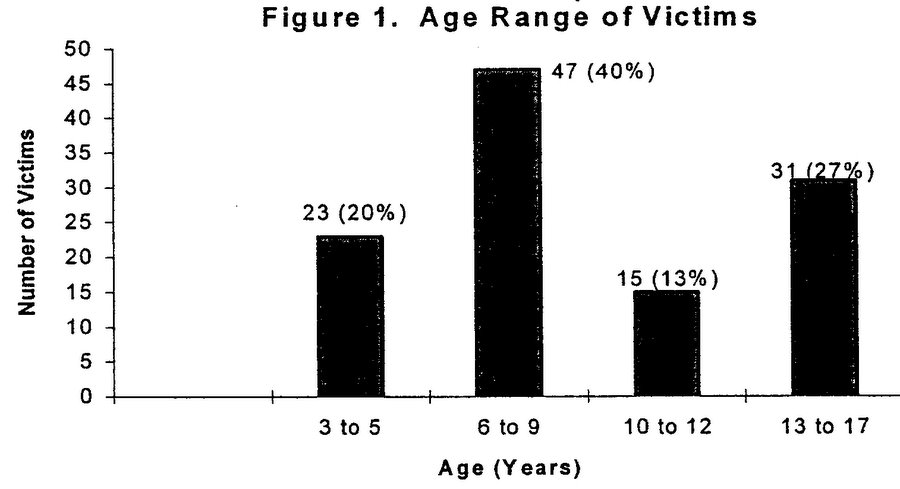
Figure 1 shows subjects ranged in age from three to 17 years. Twenty percent fell in the three to five year range; 40% in the six to nine year range, 13% in the ten to 12 year range, and 27% in the 13 to 17 year range. Sixty-two percent were female and 38% were male. Ninety-five percent were Caucasian, with 5% all minorities combined, which is reflective of the geographical area's minority population. Seven percent were from upper and upper-middle socioeconomic backgrounds, 73% from the middle, and 20% from the lower socioeconomic group.
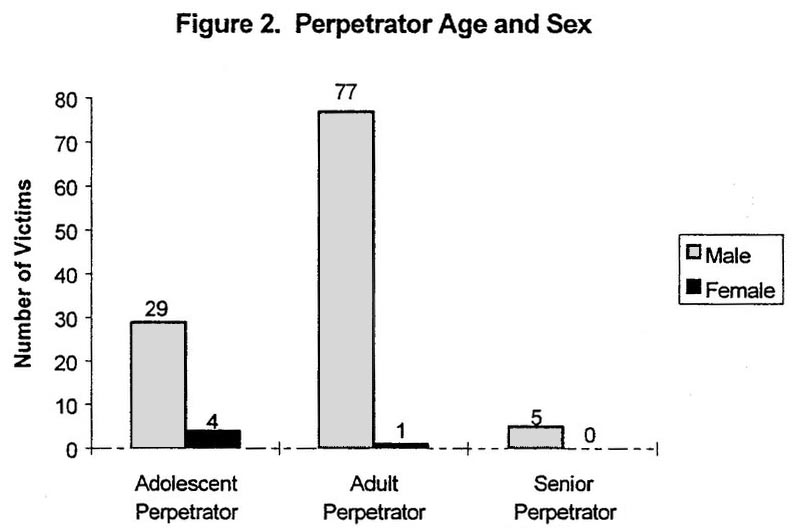
The majority of the offenders were male (96%). Figure 2 sets forth the age and sex of the perpetrators: 29 children were victims of adolescent males; four were victims of seemingly high-functioning adolescent females who abused while caregiving; 77 were victims of adult males; and one was abused by an adult female in concert with her
9
husband. Five children were molested by men over 60; no children were abused by older women.
As to the relationships of offenders to victims, 58% of the victims were abused by members of their immediate family. The percentage rose to 74% when members of the extended family were included. It is significant to note that 97% of the sample were abused by a family member or person in a position of trust and supervision of the child. None of the children were abused by strangers.
The sexual activities ranged from forms of penetration and fellatio to fondling. For 10% of the children, the sexual activity was a single occurrence; 88% were engaged in multiple incidents ranging from several months to seven years; two percent were unknown.
Results
Types of Disclosure
Table 1 examines accidental versus purposeful disclosure and reveals that accidental (74%) was clearly the most common type.
Disclosure by age grouping revealed that school-age children showed no real propensity to disclose either in a purposeful or accidental manner. But comparing preschool age three to five and adolescent 13 to 17, using the Fisher Exact Test, revealed a significant statistical correlation (p = .009). Preschool children were more likely to disclose accidentally, and adolescents were more likely to disclose purposefully.
10
| Table 1. Types of Disclosure
| ||||||
| Age (Years) | ||||||
| 3-5 | 6-9 | 10-12 | 13-17 | N | % | |
| Accidental | 21 (17.2E) |
37 (37.4E) |
12 (11.2E) |
16 (20.2E) |
86 | 74 |
| Purposeful | 2 (5,8E) |
12 (12.6E) |
3 (3.8E) |
12 (6.8E) |
29 | 25 |
| No Disclosure | 1 | 1 | 2 | 1 | ||
| 117 | 100 | |||||
| E=expected | ||||||
The history of the child and family was examined to pinpoint as accurately as possible the primary motivational factor that caused the disclosure process to begin. Table 2 lists all relevant motivational factors in the children who disclosed accidentally. Though the breakdown of data by age shows some interesting trends, the subcategory sizes are too small to draw any statistical correlations.
| Table 2. Impetus for Accidental Disclosure
| ||||||
| Age (Years) | ||||||
| 3-5 | 6-9 | 10-12 | 13-17 | N | % | |
| Exposure to Perpetrator | 3 | 6 | 6 | 9 | 24 | 28 |
| Sexual Behavior | 3 | 7 | 1 | - | 11 | 14 |
| Inappropriate Statement | 9 | 7 | - | - | 16 | 19 |
| Behavioral Sign | 3 | 5 | - | - | 8 | 9 |
| Shared Confidence | 0 | 4 | 1 | 3 | 8 | 9 |
| ID as Victim | 3 | 4 | 1 | - | 8 | 9 |
| Confession | - | 4 | 2 | 1 | 7 | 8 |
| Physical Sign | - | - | - | 2 | 2 | 2 |
| Observation | - | - | 1 | 1 | 2 | 3 |
| Total | 21 | 37 | 12 | 16 | 86 | 100 |
Exposure to perpetrator, meaning the child was known to have spent time with an alleged or convicted offender, was seen as the most frequent impetus to disclosure in all age groups — 28% of the population. Sexualized behavior that was age-inappropriate and/or excessive was commonly seen in the pre-school and young school years and was the impetus in 14% of the sample. Inappropriate statement, such as "Suck on my pee pee, Mommy," again was high in the younger age groups, which constituted 19% of the
11
total sample. A confidence was often shared by girls with a girlfriend who did not keep the secret; this was seen with children school-age and above in 9% of the sample. The impetus to disclose purposefully, as seen in Table 3, included educational awareness in 24% of the total sample and involved school programs from touch prevention to divorce and social skills groups, with early school-age children being the group most influenced. One child's disclosure was prompted by a self-assertion discussion with her mother. Influence of peers, 10% of the sample, and predominately among teens, ranged from following the example of another who disclosed, as well as encouraging and supporting a victim to disclose through the reporting process. Proximity to perpetrator, 10%, included the departure of the offender, which seemed to enable the child to feel safe enough to disclose, or plans for an impending visit from the offender, which increased the child's anxiety to the disclosure point. Timely disclosure, 22%, appeared to be situations where everything just seemed to fall into place. For example, a boy's being bathed reminded him of the sexual touching that had occurred earlier; his mother handled the discussion calmly and supportively, and the child told her about the sexual molestation. Anger was a significant impetus for purposeful disclosure, exclusively in the adolescent age group (24%).
| Table 3. Impetus for Purposeful Disclosure
| ||||||
| Age (Years) | ||||||
| 3-5 | 6-9 | 10-12 | 13-17 | N | % | |
| Education Awareness | - | 6 | 1 | - | 7 | 24 |
| Influence of Peers | - | 1 | - | 2 | 3 | 10 |
| Proximity to Perpetrator | 1 | - | 1 | 1 | 3 | 10 |
| Angry | - | - | - | 7 | 7 | 24 |
| Concern for Other | - | 1 | - | - | 1 | 3 |
| Unknown | - | 1 | - | - | 1 | 3 |
| Total | 2 | 12 | 3 | 12 | 29 | 100 |
The Disclosure Process
Figure 3 illustrates the progressive elements of the disclosure process. Almost three-fourths of all the children examined denied having been sexually abused. Denial statements were most commonly made (a) when children were initially questioned by a concerned parent or adult authority figure; and (b) when identified as potential victims and initially questioned in a formalized investigative process. Only 7% of the children who denied then moved directly to active disclosure. Tentative disclosure thus became the common middle step for the majority (78%) of these children.
12
Figure 3. Disclosure Process
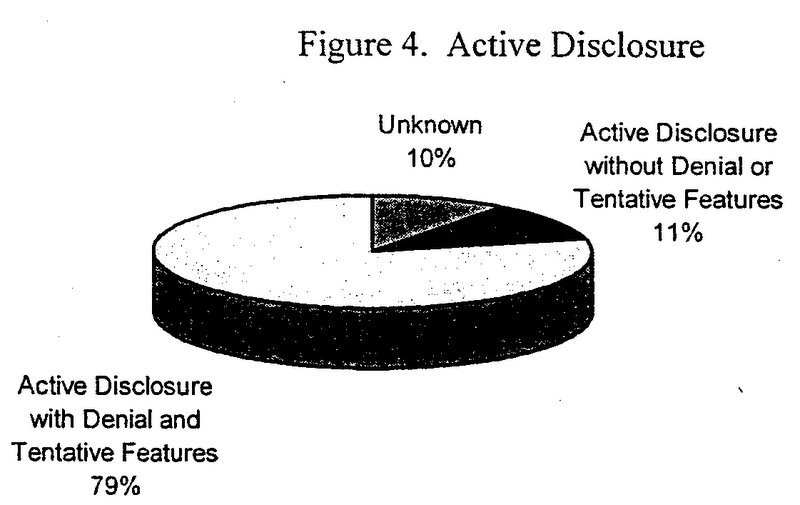
Table 4 lists the prominent features identified in the tentative disclosure phase, which presented particular concern for the authors because the children frequently appeared confused, inaccurate, and uncertain, often vacillating from acknowledgment to denial. Figure 4 shows that approximately only one out of every ten children (11%) sampled were able to provide a disclosure of sexual abuse without denying or demonstrating tentative features.
|
Table 4. Characteristics of Tentative Disclosures
| |
| Example | Category |
| "I forgot" | Forgetting |
| "It happened to Joe" "It happened a long time ago" | Distancing |
| "It only happened once" | Minimizing |
| "He tried to touch me but I hit him and ran away" | Empowerment |
| "When he puts his hands there, I go to the pink forest" | Dissociation |
| "I was only kidding" | Discounting |
13
Active disclosure was eventually made by 96% of the children, with two-thirds of the subjects being currently abused. A strong majority (10%) gave further information over time about the sexually abusive activities. "Active" disclosure meant that they were able to give a detailed, coherent, first-person account of the abuse.
In approximately 22% of the cases, children recanted their allegations. In several instances, they denied responsibility for their earlier disclosures, saying that someone else (parents, therapist) had made them say those things. Reasons for recanting are shown in Figure 5. Of those who recanted, 92% reaffirmed their abuse allegations over time.
The time frame involved in the progression to active disclosure varied and was unique to each case. Some children moved from denial to tentative to active in a single session; others took several months to reach the active phase.
Discussion
Disclosure of child sexual abuse is best described by this research as a process, not an event. The common presumption that most abused children are capable of immediate active disclosure by providing a coherent, detailed account in an initial investigative interview is not supported by these findings, which suggest that only 11% of the subjects were in active disclosure at the time of the initial interview.
This raises concern because virtually all-investigative protocols are designed to respond to only those children in active disclosure. Issues of child suggestibility, contamination,
Figure 5. Reasons to Recant
Pressure from perpetrator
Pressure from family
Negative personal consequences
Videotaping
Retelling parents
Judicial proceedings
Investigator police or CPS
The time frame involved in the progression to active disclosure varied and was unique to each case. Some children moved from denial to tentative to active in a single session; others took several months to reach the active phase.
Discussion
Disclosure of child sexual abuse is best described by this research as a process, not an event. The common presumption that most abused children are capable of immediate active disclosure by providing a coherent, detailed account in an initial investigative interview is not supported by these findings, which suggest that only 11% of the subjects were in active disclosure at the time of the initial interview.
This raises concern because virtually all-investigative protocols are designed to respond to only those children in active disclosure. Issues of child suggestibility, contamination,
14
and false allegations have increasingly restricted the amount of support that clinical, protective, and investigative systems have made available to assist children through the disclosure process. A child's initial denial, failure to provide immediate detail, or recantation may result in the dismissal of a valid complaint.
The use of terminology that acknowledges disclosure as a dynamic process through which a child progressively moves, rather than a single-outcome event, could more accurately reflect the child's circumstance and improve system response. For example, a child may describe the abuse but add an illogical ending such as, "Then I punched him in the nose and ran away," or discount a previous statement with, "I didn't mean what I said." The child could be labeled as not being credible and the complaint dismissed as unsubstantiated or, alternatively, the child could be identified as in a tentative disclosure phase that may warrant a continuing investigation.
Seventy-nine percent of the children in this study initially denied their abuse or were tentative in disclosing it. Policies and procedures geared only to those children in active disclosure not only fail to recognize the needs of the majority but may actually place children at increased risk.
An illustration of this concern is the videotaping of child disclosures during initial clinical or investigative interviews. Disclosure as a process suggests that denial and tentative features may be prominent on early interview tapes, which may then serve to impeach a child who is later capable of providing credible court testimony. An acquittal of the defendant may place the child again at risk but with fewer resources. If an informed decision directs videotaping procedures, prosecutors and expert witnesses would seek to educate judges and juries about the nature of the disclosure process.
Techniques that assess the credibility of a child's complaint by analyzing components of the statement should consider whether the child was in active disclosure at the time of evaluation, and could be considered valid only if the content of the child's statement accurately reflected what the child experienced.
Analysis of the types of disclosure, accidental versus purposeful, and the various motivations for disclosure revealed that these elements appear to be age-and development-related. The strong majority of children in this study (74%) disclosed accidentally. This most often occurred for all age groups after concern was raised about the child's exposure to an identified perpetrator. Perpetrators have been found to commit between two and five times as many crimes as they were apprehended for [Groth et al., 1982], highlighting the importance of identifying any child who has had significant exposure to a recognized perpetrator and notifying parents of the potential risk. A child's initial denial to parents or others should not be the sole basis of reassurance that abuse did not occur.
Sexualized behavior and inappropriate statements constituted the next largest categories under impetus for accidental disclosure. Together they account for a full third of all such disclosures. These behaviors were noted only in preschool and young school-age children, implying that younger children, who have less cognitive awareness and impulse
15
control, will reveal in an unplanned overt manner. This finding stresses the need for increased awareness by adults of the behaviors exhibited by younger children. Sexual acting-out behaviors by children are seen as a direct indication that the child is or has been a victim of sexual abuse [Sgroi et al., 1988]. The importance of not discounting these behaviors prematurely as "child's play" but rather seeking clarifying information is made evident by the data, especially with preschool children. They may not understand enough of what has occurred to make a conscious decision to tell, but will characteristically act out the trauma.
Purposeful disclosures took place in 25% of the cases, with adolescents being significantly more likely than their younger counterparts to consciously decide to tell, motivated mainly by anger at the perpetrator. Common thought has held that the teenager who is restricted or punished may become angry and falsely accuse a parent of abuse [Summit, 1983], but the data, in contrast, suggest that the anger at parental restrictions serves to override inhibitions and fears and becomes the fuel that drives the adolescent to disclose.
The influence of peers was also noted as a motivational factor prompting disclosure by adolescents. Strategies that promote peer support for identification and prevention of drug abuse might be modeled for similar efforts with sexual abuse.
Among primary-school-age children who purposefully told, the influence of educational awareness programs was dramatic. The programs were not exclusively on sexual abuse prevention but all identified inappropriate behaviors and stressed assertiveness and personal rights.
Children who disclosed sexual abuse in this study, whether purposefully or accidentally, most often did so only after initially denying any such contact (72%). This coincides with findings that most sexually abused children never reveal abuse during their childhood [Finkelhor 1979, 1984; Russell, 1983; Silbert, 1984]. Denial by the children in this study was not expressed merely as a passive refuting of involvement but at times involved impassioned statements where the child adamantly denied any contact. Indeed, the only person for whom denial is as great as that of the perpetrator may be the victim.
When the abuse was revealed, it most often came tentatively (78%), cloaked by the child's defenses. This phase is, therefore, a precarious time to try to distinguish a tentative disclosure from a false allegation. Time may prove a great decision-making ally, since the subjects in these valid cases progressed almost unanimously (96%) to active disclosure. The time frame to reach the disclosure varied greatly. Once children progressed to that point, however, they were able to provide a consistent first-person account with unique detail that substantiated the abuse.
Twenty-two percent of the children recanted their statements. Recanting has become a recognized phenomenon in child sexual abuse cases, particularly cases of incest, with research findings ranging from 12% to 33% [Crewdson, 1988; Faller, 1988]. Of the children who recanted their allegations, 93% later reaffirmed the original complaint of abuse. These findings may reinforce the importance of viewing disclosure as a process with phases that, like developmental tasks, can be resolved. Similarly, if the phase is
16
viewed as an isolated event that ends or limits the extent of the child's support and contact with the system, then the child may become fixed at one phase and be unable to resolve it or progress. Although not all victims experience all the phases of disclosure, recognition of the continuum encourages more effective case management and intervention.
References
Dugan, M., MacFarlane, K. Disclosure of Sexual Abuse. In: K. MacFarlane and J. Feldmeth (Eds.), Response: Child Sexual Abuse the Clinical Interview. New York: Guilford, 1988, pp. 21-24.
Dziech, B., Schudson, C. On Trial. Boston, MA: Beacon Press, 1989.
Faller, K.C. Child Sexual Abuse. New York: Columbia University Press, 1988.
Finkelhor, D. Sexually Victimized Children. New York: Free Press, 1979.
Finkelhor, D. Child Sexual Abuse: New Theory and Research. New York: Free Press, 1984.
Groth, A.N., Longo, R.E., McFadin, J.B. Undetected Recidivism among Rapists and Child Molesters. Crime and Delinquency 1982,28:450-458.
Hechler, D. The Battle and the Backlash. Lexington, MA: Lexington Books, 1988.
Lister, E. Forced Silence: Neglected Dimensions of Trauma. American Journal of Psychiatry 1982, 139(7):872-876.
Lloyd, D. The Corroboration of Sexual Victimization of Children. In: J. Bulkley (Ed.), Child Sexual Abuse and the Law. Washington, DC: American Bar Association, 1982.
MacFarlane, K., Krebs, S. Techniques for Interviewing and Evidence Gathering. In: K.
MacFarlane and J. Waterman (Eds.), Sexual Abuse of Young Children. New York: Guilford, 1986, pp. 67-100.
National Center on Child Abuse and Neglect Study of National Incidence and Prevalence of Child Abuse and Neglect: 1988. Washington, DC: US Government Printing Office, 1988.
Russell, D. The Incidence and Prevalence of Intrafamilial and Extra-familial Sexual Abuse of Female Children. Child Abuse and Neglect 1983,7:33-146.
Sahd, D. Psychological Assessment of Sexually Abusing Families and Treatment Implications. In: W. Ho lden (Ed.), Sexual Abuse of Children: Implications for Treatment. Englewood, CO: American Humane Association, 1980, pp. 71-86.
Sauzier, M. Disclosure of Child Sexual Abuse. Psychiatric Clinics of North America, June 12, 1989:455-469.
Sgroi, S., Blick, L., Porter, F. A Conceptual Framework for Child Sexual Abuse. In: S. Sgroi (Ed.), Handbook of Clinical Intervention in Child Sexual Abuse. Lexington, MA: Lexington Books, 1982, pp. 9-37.
17
Sgroi, S., Bunk, B., Wabrek, C. Children's Sexual Behaviors and Their Relationship to Sexual Abuse. In: S. Sgroi (Ed.), Vulnerable Populations. Lexington, MA: Lexington Books, 1988, 1-24.
Silbert, N. Treatment of Prostitute Victims of Sexual Assault. In: I.R. Stuart and J.G. Greer (Eds.), Victims ofSexual Aggression: Treatment of Children, Women and Men. New York: Van Nostrand Reinhold, 1984, pp. 251-269.
Summit, R. The Child Sexual Abuse Accommodation Syndrome. Child Abuse and Neglect 1983, 7:177-193.
18
Reprinted with permission from:
Burkhart, M. (1999). "I take it back": When a child recants. Update. 12, (3).
"I Take It Back": When A Child Recants.
Mary-Ann Burkhart'
At one point or another during our careers, every professional in the child abuse arena will be faced with a recanting child victim or witness. Recantation occurs at various stages during the investigation or prosecution of child abuse cases. A recantation may derail a case retrial, during the trial, or even subsequent to a verdict being rendered.
A child may recant for a variety of reasons, including secrecy, inducements by perpetrators, lack of support from the non-offending caregiver, societal attitudes regarding the sexual abuse of children, or the child's interactions with professionals within the criminal justice system.
19
Remembering the typical reasons for recantation, we as professionals should strive to prevent our child victims from recanting by keeping in mind the following guidelines:
20
Despite all of these precautions, the child still may recant. At that time, the report of recantation needs to be objectively assessed, the case needs to be assessed for further prosecution, and the child's credibility needs to be rehabilitated.
Any possible witnesses to the recantation should be interviewed, with the foregoing questions asked of them as well. The child's therapist should be contacted to learn more about the child's home situation. Some possible areas of exploration are the level of support for the child, whether there has been compliance with court orders in place, and what the plans are for the child's immediate future. Additionally, all witnesses to the child's original statement should be interviewed, and questions regarding the child's demeanor and exact words at the time of disclosure need to be explored.
As outlined above, children recant for a number of reasons. If prosecutors routinely dismiss cases involving recanting victims, these children and other children may not
21
be safe. If children do not disclose having been sexually abused, they may not be able to overcome the trauma of the abuse. Furthermore, child sexual abusers may take the threat of prosecution less seriously.
As shown, a number of interventions can be made to prevent recantation and to minimize its effects. Victims of sexual abuse should have advocates appointed for them early in the proceedings to provide them with early and continual support. Both children and abusers should receive mental health treatment directly following disclosure as another source of support the children. Finally, judicial changes should take place so the experience of testifying and gathering evidence is less traumatic of the children.
i Senior Attorney, APRI's National Center for the Prosecution of Child Abuse.
ii Roland C. Summit, M.D., The Child Sexual Abuse Accommodation Syndrome, 7 CHILD ABUSE AND NEGLECT 177-193 (1985).
iii FEDERAL RULES OF EVIDENCE 803 (4).
iv FEDERAL RULES OF EVIDENCE 803 (24).
v Many state legislatures have enacted statutes to admit a child's statement into evidence provided the trustworthiness of the statement can be established. See CHILD ABUSE AND NEGLECT STATE STATUTE SERIES 1998, Volume IV, Number 23, Child Witnesses: Child Hearsay Exceptions (National Clearinghouse on Child Abuse and Neglect Information & APRI's National Center for Prosecution of Child Abuse).
vi FEDERAL RULES OF EVIDENCE 803 (1).
vii FEDERAL RULES OF EVIDENCE 803 (2).
viii There are, however, three notable exceptions: Kentucky - Newkirk v. Commonwealth, 937 S. W. 2d 690 (Ky. 1996); Pennsylvania - Commonwealth v. Dunkle, 529 Pa. 168, 602 A. 2d 830 (Pa. 1992); and Tennessee - State v. Anderson, 880 S.W.2d 720 (Tenn. Crim. App. 1994).
end
American Prosecutors Research Institute 2004 CornerHouse
Finding Words Training Manual